
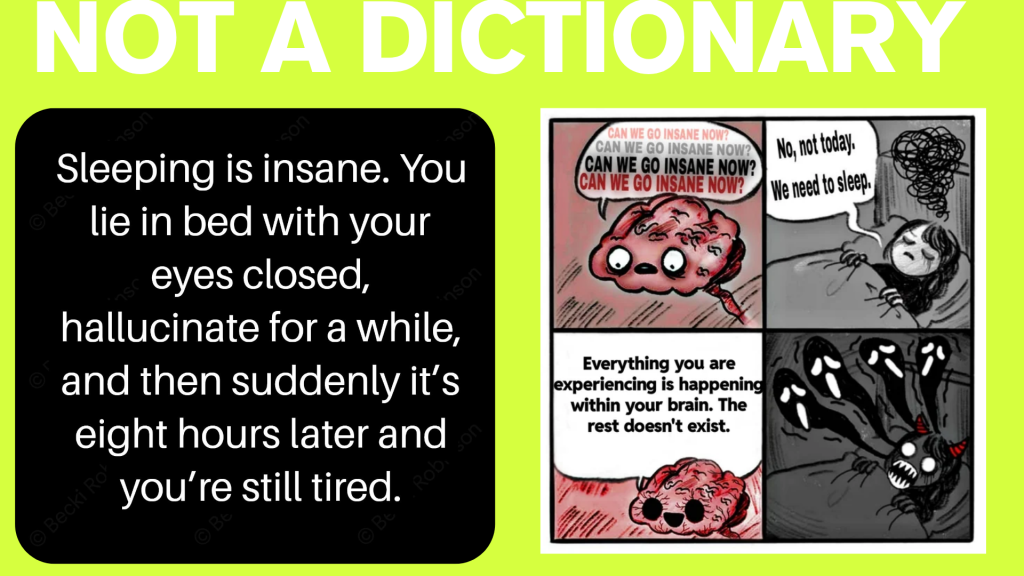
Pay attention to the construction «with your eyes closed». This is a very common and convenient phrase! Instead of the long «and your eyes are closed», we speak briefly and succinctly: «with + object + participle». More examples: «He stood there with his mouth open», «She left with the door unlocked».
What is more important: «closed» and «tired» are not past tense verbs, but participles (Past Participle). This often causes confusion. Yes, in English, *-ed* is not always a verb ending.
«close» is a verb, an action. «You close your eyes» — that is something you do.
«closed» here describes not an action, but a state. As a result of an action. You have already performed the action «close», and now your eyes are in the state of «closed».
Why not “with closed eyes?”
«with closed eyes» — that is POSSIBLE, but if you say with closed eyes, the focus shifts to the eyes themselves as an object. The whole phrase sounds literally like: «with closed eyes». «It’s dangerous to drive a car with closed eyes.» — Here it is specifically about the physical state of the eyes. «With your eyes closed» — this is about YOUR STATE and SENSATIONS.
With closed eyes — focuses on the eyes. (What kind of eyes? Closed.)
With your eyes closed — focuses on you, who is lying in the condition of having your eyes closed.
In 95% of cases, when talking about personal experience, sensations, or describing a scene involving a person, native speakers will say with your eyes closed. It is more habitual, more natural, and conveys the meaning more precisely.