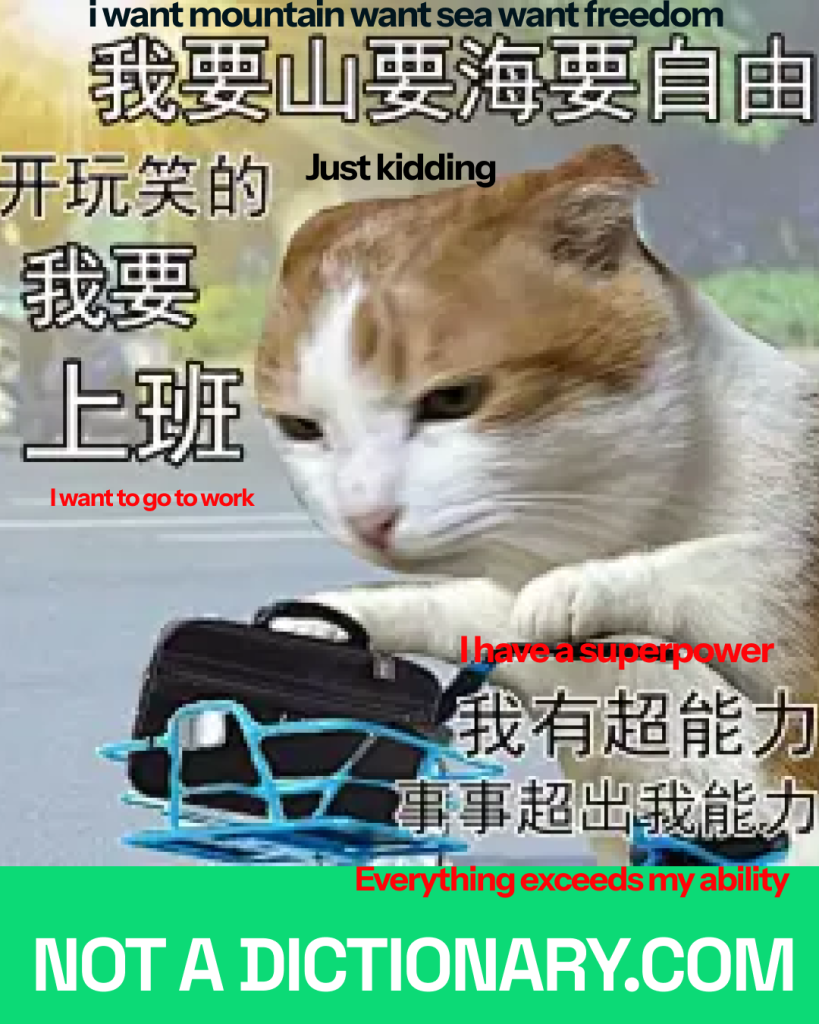
要 here is a normal verb meaning “want.” Repeating it three times is stylistic (for rhythm), not grammatical.
开玩笑的
Character
Pinyin
English
开
kāi
to open
玩
wán
to play
笑
xiào
to laugh
的
de
(completion particle)
开玩笑 as a whole means “to joke.” The 的 at the end makes the phrase complete and final. In casual speech, 开玩笑的 = “just kidding.”
我要上班
Character
Pinyin
English
我
wǒ
I
要
yào
want
上
shàng
to go up / to go to
班
bān
shift / work
上班 means “to go to work” (the daily routine). Not the same as 工作 (job/profession). The punchline works because 上班 is deliberately boring after “mountains, sea, freedom.”
我有超能力
Character
Pinyin
English
我
wǒ
I
有
yǒu
have
超
chāo
super-
能
néng
ability
力
lì
power
超能力 = superpower.
事事超出我能力
Character
Pinyin
English
事
shì
thing / matter
事
shì
thing / matter
超
chāo
to exceed
出
chū
to go out (of)
我
wǒ
my
能
néng
ability
力
lì
power
事事 = reduplication of 事 → “every single thing” (same pattern as 天天 = every day, 人人 = every person)
超出 = transitive verb — it MUST have an object. Here the object is 我的能力 (my ability)
The joke: 超能力 (superpower) → 超出 my 能力 (exceeds my regular ability). The 超 moves from “super” (good) to “exceeds” (bad).