
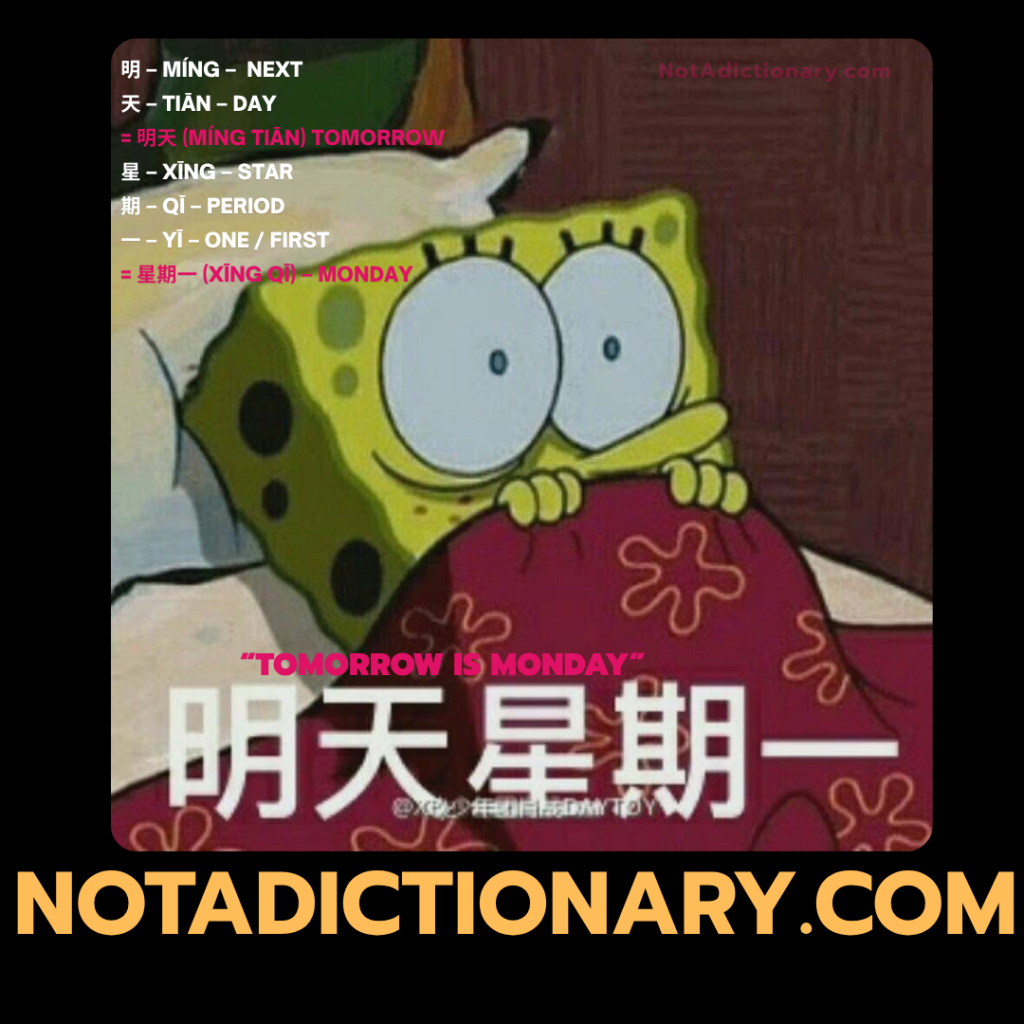
明天星期一 (míng tiān xīng qī yī) — Tomorrow is Monday
明天 – míng tiān – tomorrow
星 – xīng – star
期 – qī – period / cycle
= 星期 – xīng qī – week (“star cycle” — the ancient Chinese tracked weeks by celestial cycles)
一 – yī – first (position in a sequence, not counting a quantity)
星期一 – xīng qī yī – Monday (literally “week day one”)
= Tomorrow is Monday
Zero-copula sentence in Chinese language
! This is a zero-copula sentence — there is no verb “is” in Chinese. You simply place the two ideas next to each other: 明天 (tomorrow) + 星期一 (Monday) = “Tomorrow is Monday.” No 是 (shì / to be) needed. The sentence stands on its own. The listener will understand.
“Week day one” is monday in Chinese
! Chinese names the days of the week by number: 星期一 (Monday = week-day-1), 星期二 (Tuesday = week-day-2), all the way to 星期六 (Saturday = week-day-6). Sunday breaks the pattern: 星期日 or 星期天 — using 日 (sun/day) or 天 (sky/day) instead of a number.
一 (yī) — when “one,” when “first”
一 alone = one (the number): 一个人 ( one person); 星期一 = Monday: here 一 = first (the first day of the week) 第一 (dì yī) = first place: 第 is a prefix that formally signals “ordinal,” so 一 = first
When 一before another number or measure word it means ONE. Wehn 一 after 第 (dì) it means FIRST. So in 明天星期一, the 一 is simply the number “one” (day one of the week = Monday), not the ordinal “first”. That’s why no 第 is needed. In Chinese, they say: Two day of the week = Tuesday / One day of the week = Monday. Why they say this exact way? – There is no reason, this is how their language works, so don`t overthink another way of thinking.