

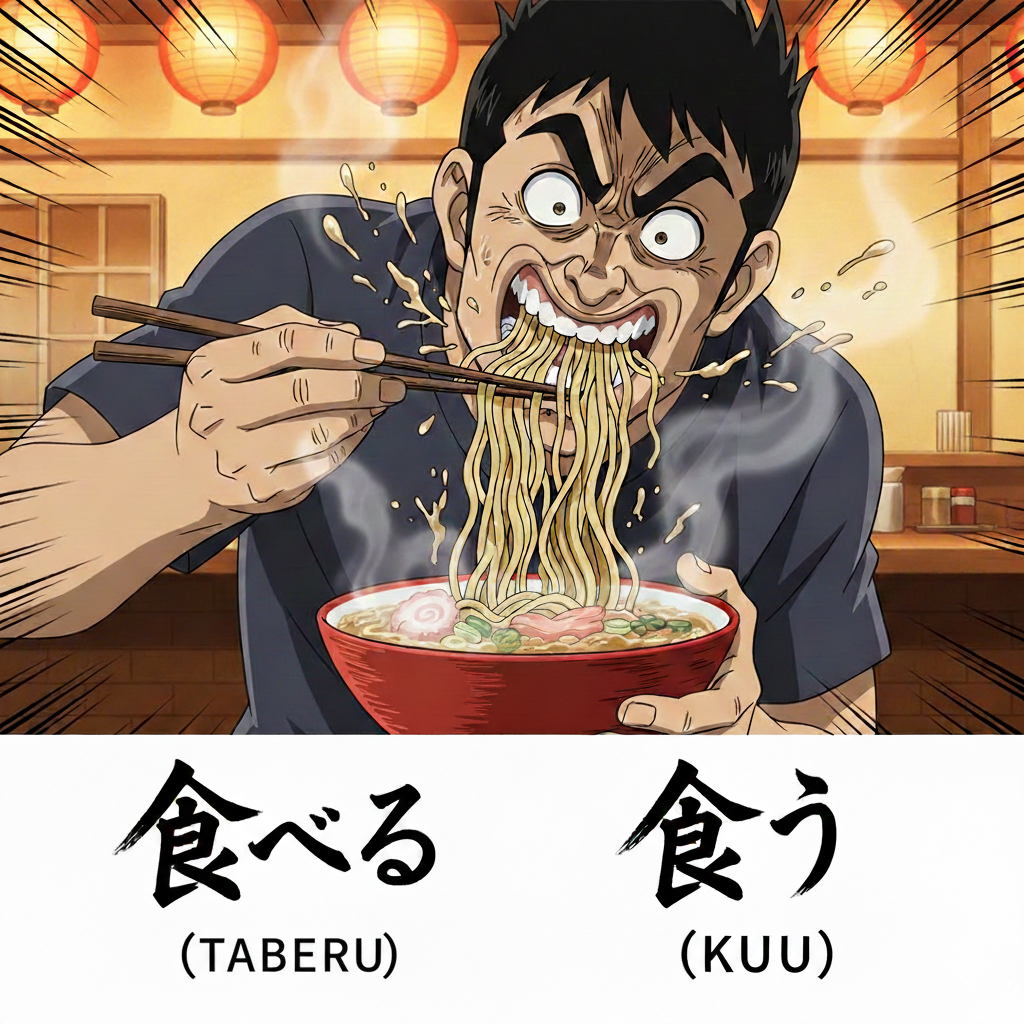
Both 食べる (taberu) and 食う (kuu) are verbs that mean “to eat.” However, their usage is defined almost entirely by register, politeness, and social context.
食べる (Taberu) is the standard, neutral verb for “to eat.” It is polite enough for formal situations (when conjugated appropriately) and completely natural for everyday, polite conversation. You can use it with anyone—strangers, colleagues, family, and friends—without causing offense. It is the verb you will learn first in any textbook or class.
食う (Kuu) is a rough, blunt, and masculine verb. It originates from classical Japanese and in modern usage carries a strong sense of vulgarity, toughness, or familiarity. You can offent hear these in aggressive situations or between male friends. A gangster in a movie saying, “Eat this!” これ、食らえ! Kore, kurae!
- 食べる is the polite, standard, and safe choice for almost all situations.
- 食う is abrupt, informal, and loaded with masculine or vulgar nuance. Using it in the wrong context (e.g., with a superior, in a formal setting, or by a woman in general conversation) would be considered extremely rude, shocking, or socially awkward.
| • 朝ごはんを食べました。 Asa-gohan o tabemashita. (I ate breakfast.) • もっと野菜を食べてください。 Motto yasai o tabete kudasai. (Please eat more vegetables.) | • 飯、食ったか? Meshi, kutta ka? (Hey, you eaten yet?) [Very rough male speech] • この野郎! くってやる! Kono yarō! Kutte yaru! (You bastard! I’ll take you down!) [Aggressive] • Idiom: 時間に食われる。 Jikan ni kuwareru. (To be pressed for time. / Lit: To be eaten by time.) |
食べる (Taberu) Conjugation Patterns
食べる is a Ru-verb (Ichidan verb). Its stem is tabe-, and it conjugates in a regular, predictable way by dropping the -ru and adding endings.
| Form (Purpose) | Conjugation | Example from Your List |
|---|---|---|
| ます Form (Polite Past) | 食べました tabe-mashita | 朝ごはんを食べました。 Asa-gohan o tabemashita. (I ate breakfast.) |
| て Form + ください (Polite Request) | 食べて tabe-te | もっと野菜を食べてください。 Motto yasai o tabete kudasai. (Please eat more vegetables.) |
| Dictionary Form (Casual Present/Future) | 食べる taberu | 毎日パンを食べる。 Mainichi pan o taberu. (I eat bread every day.) |
| ない Form (Casual Negative) | 食べない tabe-nai | 彼は肉を食べない。 Kare wa niku o tabenai. (He doesn’t eat meat.) |
| た Form (Casual Past) | 食べた tabe-ta | 昨日寿司を食べた。 Kinō sushi o tabeta. (I ate sushi yesterday.) |
食う (Kuu) Conjugation Patterns
食う is a U-verb (Godan verb). Its dictionary form ends in -u, and the consonant (k-) changes before different vowels.
| Form (Purpose) | Conjugation (Stem: Ku-) | Example from Your List & More |
|---|---|---|
| た Form (Casual Past) + か (Question Particle) | 食ったKu → Kut-ta | 飯、食ったか? Meshi, kutta ka? (Hey, you eaten yet?) The つ in くつ is shortened to っ. |
| て Form (Connective form, used for commands/continuous) | 食ってKu → Kut-te | この野郎! 食ってやる! Kono yarō! Kutte yaru! (You bastard! I’ll take you down!) Here, 食ってやる is a threatening promise: “I’ll eat you up!” (figuratively). |
| られる Form (Passive Voice) | 食われるKu → Kuwa-reru | 時間に食われる。 Jikan ni kuwareru. (To be pressed for time. / Lit: To be eaten by time.) This is the passive form used idiomatically. |
| Dictionary Form (Casual) | 食う kuu | しっかり食え! Shikkari kue! (Eat heartily!) Imperative form 食え is very rough. |
| ない Form (Casual Negative) | 食わないKu → Kawa-nai | 今日は何も食わない。 Kyō wa nanimo kuwanai. (I won’t eat anything today.) [Very blunt] |
Quick Conjugation Comparison Table
| Purpose | 食べる (Ru-verb) | 食う (U-verb) | Politeness Level |
|---|---|---|---|
| Polite Past | 食べました (tabemashita) | 食いました (kuimashita)* | 食べる: Normal polite 食う: Rarely used in this form |
| Casual Past | 食べた (tabeta) | 食った (kutta) | 食べる: Neutral casual 食う: Rough casual |
| て Form (Request) | 食べてください (tabete kudasai) | 食ってくれ (kutte kure) | 食べる: Polite request 食う: Demanding, rough request |
| Negative | 食べない (tabenai) | 食わない (kuwanai) | 食べる: Neutral negative 食う: Blunt negative |
| Passive | 食べられる (taberareru) | 食われる (kuwareru) | Often used in idioms |