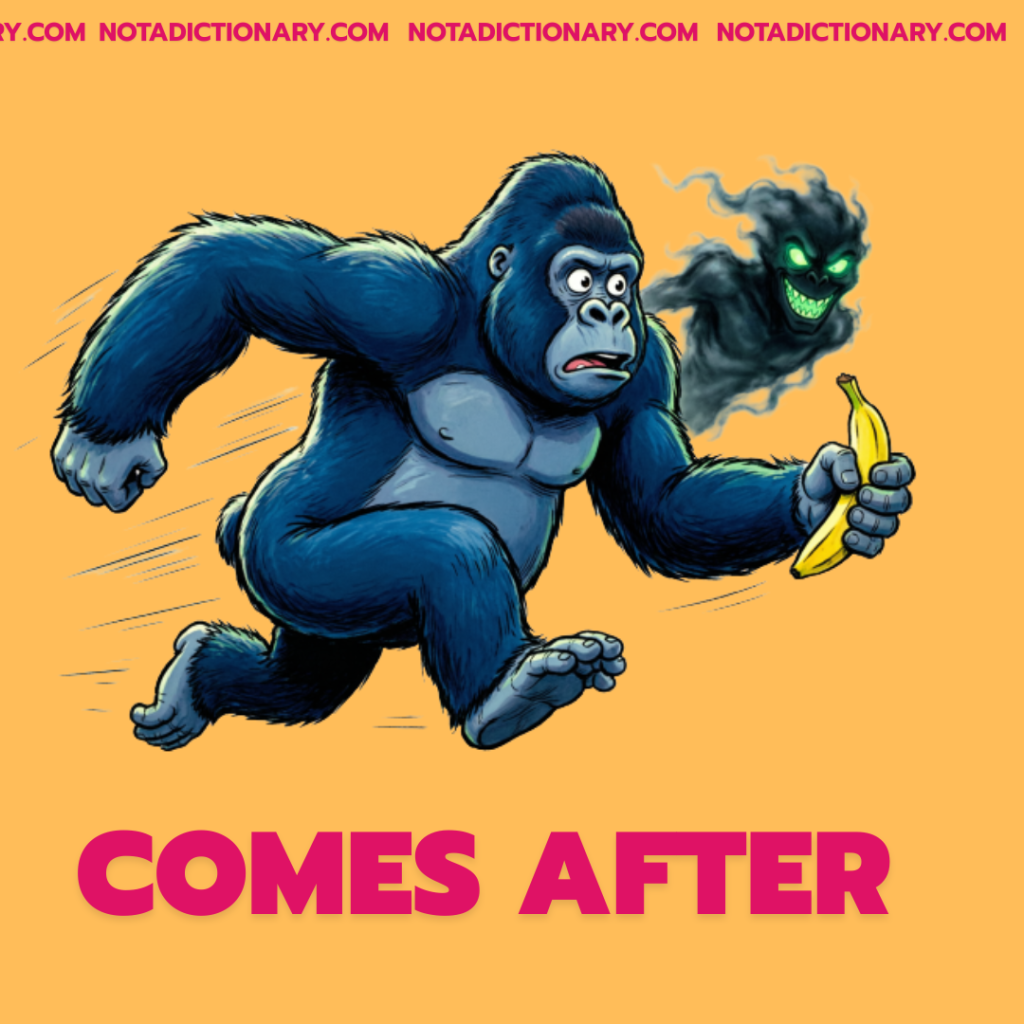
The One Universal Meaning of AFTER. AFTER = Following in time, space, sequence, or desire — a directional or temporal relationship where one thing comes behind another.
Think of it like this: One thing moves or comes behind another. Imagine one person running behind another, or one event happening right after another. There is a sense of chasing, seeking, caring, copying, or desiring — always with something coming after something else.
Important Grammar Note for “AFTER”
Most AFTER phrasal verbs are inseparable . The verb and “after” stay together, and the object always comes after:
✅ “She looks after her brother.”
❌ “She looks her brother after.”
✅ “She looks after him.”
❌ “She looks him after.”
Exception: With name after and pattern after, the object can sometimes come between in passive or formal constructions, but generally, treat all AFTER phrasal verbs as inseparable.
✅ “They named her after her aunt.”
✅ “They named after her aunt.” (Both correct)
PATTERN 1: PHYSICAL CROSSING (SPACE)
Core Idea: Moving from one side to the opposite side of a physical space, surface, or barrier.
come across – Cross to the other side.
“Come across the street to my house.”
go across – Travel to the other side.
“We went across the bridge.”
walk across – Cross by walking.
“He walked across the field.”
run across – Cross by running.
“The child ran across the road.”
swim across – Cross by swimming.
“She swam across the lake.”
drive across – Cross by vehicle.
“We drove across the desert.”
fly across – Cross by air.
“They flew across the ocean.”
look across – Look to the other side.
“He looked across the room at her.”
cut across – Go directly across as a shortcut.
“Let’s cut across the field to save time.”
live across – Live on the opposite side.
“She lives across the street.”
PATTERN 2: MEET / FIND BY CHANCE (ENCOUNTER)
Core Idea: Encountering something or someone unexpectedly without planning.
come across – Meet or find by chance.
“I came across an old photo.”
run across – Meet unexpectedly.
“I ran across my old teacher.”
stumble across – Find by accident.
“I stumbled across a secret path.”
happen across – Find unexpectedly.
“We happened across a beautiful village.”
drop across – Meet by chance (less common).
“I dropped across an interesting fact.”
cut across – Meet or intersect in an abstract way.
“Our interests cut across many areas.”
PATTERN 3: COMMUNICATE / BE UNDERSTOOD
Core Idea: An idea or message crosses from one mind to another successfully.
get across – Communicate successfully.
“I couldn’t get my point across.”
put across – Explain clearly; communicate.
“She put across her ideas well.”
get across – Be understood (intransitive).
“Does my message get across?”
bring across – Make understandable.
“Can you bring across the main idea?”
put across – Perform convincingly (theater, speech).
“The actor put across his emotions well.”
come across – Be understood or perceived in a certain way.
“He comes across as very confident.”
PATTERN 4: IMPRESSION / PERSONAL QUALITY
Core Idea: How someone or something is perceived by others.
come across – Create an impression.
“She comes across as friendly.”
come across – Appear in a certain way.
“He comes across as honest.”
come across – Be viewed by others.
“The message comes across as angry.”
put across – Convey a personal image.
“She puts across a professional image.”
PATTERN 5: OBSTACLE / BARRIER CROSSING
Core Idea: Overcoming a difficulty, problem, or barrier.
get across – Overcome a communication barrier.
“I finally got my idea across to the team.”
put across – Push through resistance.
“He put across his proposal despite objections.”
come across – Successfully navigate a difficult situation.
“She came across as strong during the crisis.”
PATTERN 6: LATERAL MOVEMENT (NO CHANGE IN LEVEL)
Core Idea: Moving horizontally without going up or down.
slide across – Move smoothly over a surface.
“The ice skater slid across the rink.”
glide across – Move gracefully.
“The boat glided across the water.”
stretch across – Extend from one side to another.
“The bridge stretches across the bay.”
spread across – Cover a surface.
“The fire spread across the field.”
PATTERN 7: TIME / DURATION (FIGURATIVE)
Core Idea: Extending through a period of time.
carry across – Continue through time.
“Traditions carried across generations.”
reach across – Extend through time.
“The influence reached across centuries.”
live across – Exist through a period.
“His legacy lives across the ages.”
PATTERN 8: DISCOVERY (INFORMATION)
Core Idea: Finding information or truth unexpectedly.
come across – Discover information.
“I came across a fascinating fact in the book.”
run across – Find data or news.
“I ran across an article about that topic.”
stumble across – Discover accidentally.
“She stumbled across the solution while experimenting.”
PATTERN 9: CONNECTION / LINKING
Core Idea: Connecting two separate things or groups.
reach across – Connect between different groups.
“The organization reaches across political divides.”
cut across – Link different categories.
“Her work cuts across multiple disciplines.”
bridge across – Connect two things.
“The program bridges across communities.”
PATTERN 10: PERCEPTION / SENSORY
Core Idea: Something being detected by senses.
come across – Be heard or understood through sound.
“Her voice came across clearly on the radio.”
come across – Be visible or noticeable.
“The message came across loud and clear.”
get across – Be received by senses.
“The alarm got across to everyone in the building.”
PATTERN 11: TRANSFER / MOVEMENT OF OBJECTS
Core Idea: Moving an object from one place to another.
pass across – Move something to the other side.
“Pass the ball across the field.”
send across – Transmit to the other side.
“Send the document across to my office.”
throw across – Toss to the other side.
“He threw the rope across the river.”
PATTERN 12: COMPARISON / CONTRAST
Core Idea: Comparing two different things or ideas.
draw across – Compare by bringing together.
“The author draws across different historical periods.”
cut across – Contrast by showing differences.
“His opinion cuts across the usual views.”