Self-deprecating meme — making fun of terrible fashion sense for work.
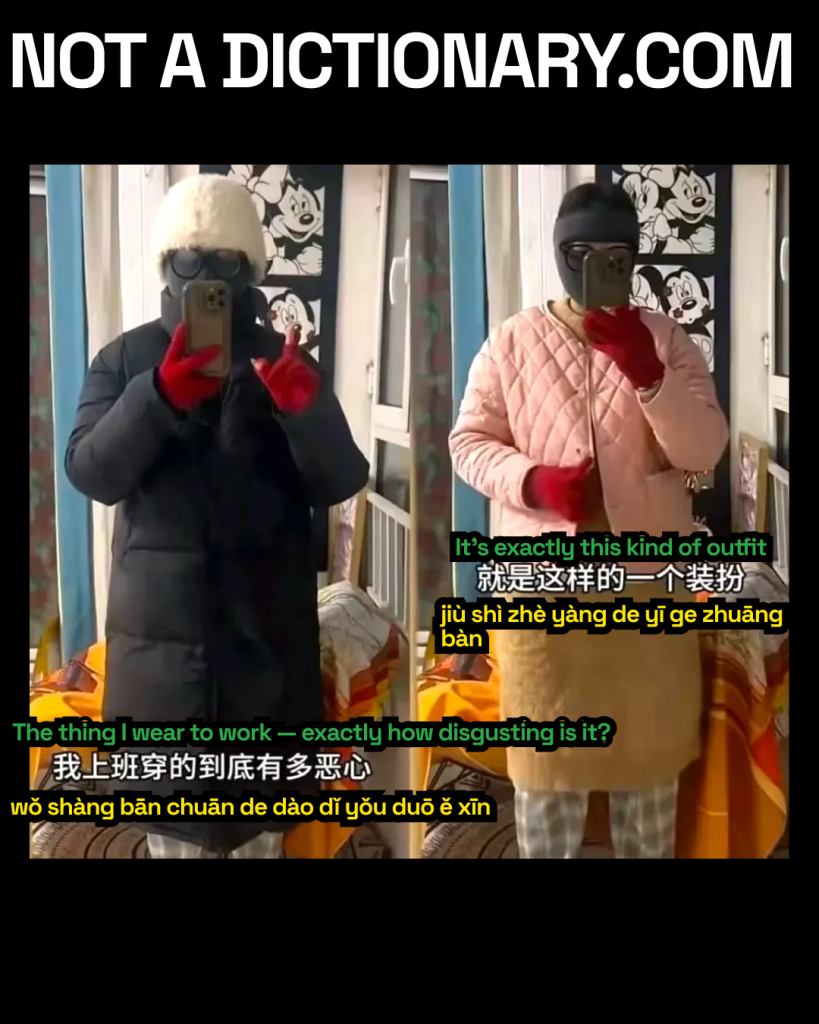
就是这样的一个装扮 (jiù shì zhè yàng de yī ge zhuāng bàn)
├── 就是 (jiù shì) = “exactly is” / “it’s just”
│ ├── 就 (jiù) = exactly / precisely (emphasizes what follows)
Because it’s paired with 是 (to be) right after it → 就是 = “exactly is”
│ └── 是 (shì) = to be
│
├── 这样的 (zhè yàng de) = “this kind of”
│ ├── 这样 (zhè yàng) = this way / like this
│ └── 的 (de) = modifying particle (links to the noun)
│
├── 一个 (yī ge) = “one” (measure word for items/outfits)
│ ├── 一 (yī) = one
│ └── 个 (gè) = general measure word
│
└── 装扮 (zhuāng bàn) = “outfit” / “look” / “dress-up style”
├── 装 (zhuāng) = dress / pretend / outfit
└── 扮 (bàn) = play the role of / disguise
→ Direct translation: “It’s exactly this kind of outfit”
→ Natural: “This is the outfit I wear” (implying: you’re about to see or imagine it)
我上班穿的到底有多恶心 (wǒ shàng bān chuān de dào dǐ yǒu duō ě xīn)
├── 我 (wǒ) = I / me
│
├── 上班 (shàng bān) = go to work
│ ├── 上 (shàng) = go up / go to
│ └── 班 (bān) = shift / work
│
├── 穿 (chuān) = wear (clothes)
│
├── 的 (de) = nominalization particle
│ → turns “我上班穿” (I wear to work) into a noun phrase: “the thing I wear to work”
│
├── 到底 (dào dǐ) = “on earth” / “exactly” (adds strong emotion — frustration, shock, emphasis)
│ ├── 到 (dào) = to reach / arrive at
│ └── 底 (dǐ) = bottom / end
│ → together: “to the bottom” → figuratively “get to the bottom of this “
│
├── 有 (yǒu) = have / is (for describing degree)
Because it’s followed by 多 + adjective: 有多恶心 = “is how disgusting”
│
├── 多 (duō) = “how” (for asking or exclaiming about degree)
│ → 有多恶心 = “how disgusting”
│
└── 恶心 (ě xīn) = disgusting / makes you want to vomit
├── 恶 (ě) = disgust / evil
└── 心 (xīn) = heart / mind
→ Direct translation: “The thing I wear to work — exactly how disgusting is it?”
→ Natural: “Just how ugly is the stuff I wear to work?”
The particle 的 (de) does TWO different jobs here
First 的 (in 这样的): 就是这样的一个装扮
这样 = “this way”
这样的 = “this kind of” (describes the next noun)
Example: 这样的人 = this kind of person
Second 的 (in 我上班穿的): 我上班穿的到底有多恶心
This turns a whole sentence into a noun phrase!
我上班穿 = “I go-to-work wear”
我上班穿的 = “the thing that I wear to work”
You don’t need to say “clothes” — 的 does the job.
Compare:
- 我吃的 = the thing I eat (food)
- 你写的 = the thing you write (text)
- 我上班穿的 = the thing I wear to work (my outfit)
到底 (dào dǐ) = emotion word for frustration
Think of 到底 as adding “on earth” or “seriously though”:
| Chinese | Vibe |
|---|---|
| 你是谁? | Who are you? (neutral) |
| 你到底是谁? | Who on earth are you? (impatient/suspicious) |
| Chinese | Vibe |
|---|---|
| 有多恶心? | How disgusting? (neutral question) |
| 到底有多恶心? | Just how disgusting is it? (emotional — I can’t believe it!) |
我上班穿的到底有多恶心
“Seriously though — how disgustingly do I dress for work?”
The speaker is embarrassed or joking about themselves.
有多 + adjective = “how (adjective)”
Pattern: 有 + 多 + Adjective
有多大? = How big is it?
有多好? = How good is it?
你有多累? = How tired are you
In meme: 有多恶心 = “how disgusting”
HOW SENTENCES WERE BUILT
就是这样的一个装扮
- 就 = exactly (adverb — emphasizes what follows)
- 就是 = exactly is (就 + 是 = “it is exactly”)
- 就是这 = exactly is this (这 = this — pointing to something)
- 就是这样 = exactly is this way (这样 = “this way” / “like this”)
- 就是这样的 = exactly is this way de (的 = modifier particle — connects “this way” to the next noun)
- 就是这样的一个 = exactly is this way de one (一 = one — measure word coming)
- 就是这样的一个装扮 = exactly is this way de one outfit (装扮 = “outfit” / “look”)
“It is exactly this kind of outfit”
我上班穿的到底有多恶心
- 我 = I (subject — the person doing the action)
- 我上班 = I go to work (上班 = verb “go to work”)
- 我上班穿 = I go to work wear (穿 = wear — still missing an object)
- 我上班穿的 = I go to work wear de (的 turns the clause into a noun phrase = “the thing that I wear to work”)
- 我上班穿的到底 = I go to work wear de on earth (到底 adds emotion/frustration = “seriously”)
- 我上班穿的到底有 = I go to work wear de on earth is (有 here = “is” — degree marker, not possession)
- 我上班穿的到底有多 = I go to work wear de on earth is how (多 = “how” — asks about degree)
- 我上班穿的到底有多恶心 = I go to work wear de on earth is how disgusting (恶心 completes the pattern = “how disgusting”)
“The thing I wear to work — seriously, how disgusting is it?”