Try saying it three times fast. Most people can’t even say it once — which is exactly why it’s become an unofficial sobriety test in Russian.
The word itself is a small monster: four prefixes stacked in a row — из-, под-, вы-, под- — piled onto one root, like a tongue-twister built by committee.
Its cousin, переподвыподверт(perepodvyvodvyort), actually means something: a needlessly convoluted way of explaining things. Twisting an idea so many times the listener loses the thread. Fittingly, it’s also slang for a somersault — a body doing in motion what the word does in sound.
d’aller te coucher — to go to bed and why we have Te = yourself here?
d’aller — to go te — yourself (reflexive pronoun) coucher — to lie down / to go to bed
So if you want to say you’re going to bed — not putting someone else to bed, but doing it to yourself — French makes you say it out loud. You have to stick in a little word that means “myself” or “yourself,” right in the middle of the sentence, like you’re pointing back at yourself.
“Tu vas te coucher” is literally “you’re going to put-yourself to bed.” Nobody in French thinks about it that hard — it’s just the normal way to say “you’re going to bed” — but structurally, that “te” is doing the job of saying “this action is landing back on you, not on someone else.”
Same deal with makeup. “Maquiller” means “to put makeup ON someone” — like a makeup artist doing someone’s face. So when you say “je me maquille,” you’re saying “I’m doing-makeup to myself.” The “me” is what tells you it’s not someone else’s face getting painted, it’s your own.
Subject
Reflexive pronoun
Example
je
me
je vais me coucher (to lie down, put to bed, or go to sleep)
tu
te
tu vas te coucher
il/elle
se
il va se coucher
nous
nous
nous allons nous coucher
vous
vous
vous allez vous coucher
ils/elles
se
ils vont se coucher
That’s it. That’s the whole feeling: these verbs are naturally about acting on someone else, and French forces you to insert “myself/yourself/ourselves” whenever the person doing it and the person receiving it are the same. English just doesn’t bother — we say “I’m getting up,” we don’t say “I’m getting myself up” every time, even though that’s basically what’s happening. French says it every single time. That’s the whole reason “te” is sitting there looking confusing — it’s not adding meaning, it’s just French’s way of always naming who the action is bouncing back onto.
🔥 French through Memes
🐸 Meme
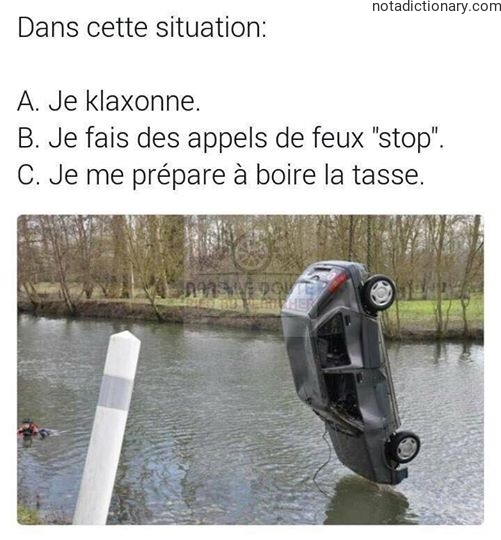
Learn French With Memes: The Car Accident
Oops! Waterlogged car.
🔥 French through Memes
🐸 Meme
Learn French With Memes: Faillait Bien Que Ca Arrive