
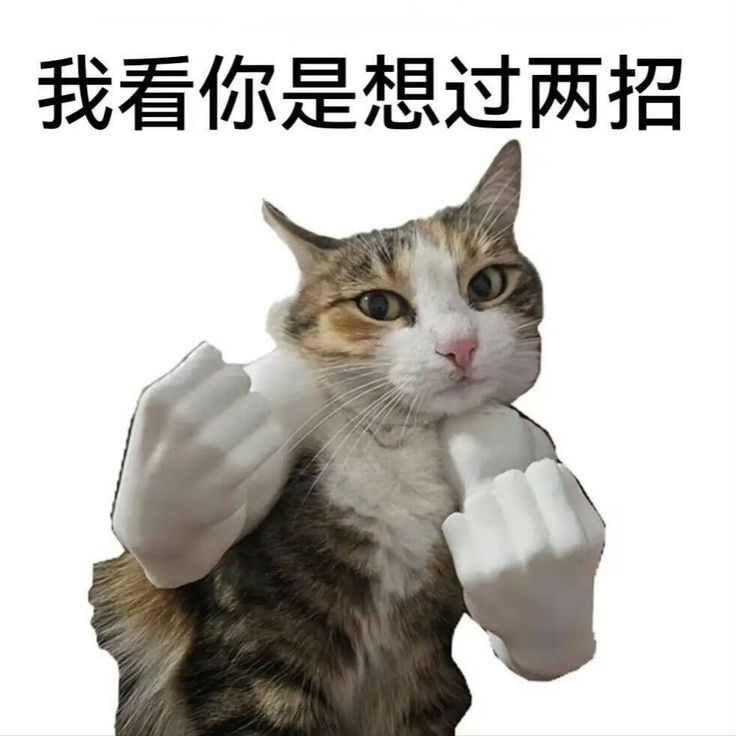
You’ve probably seen the meme: a calico cat sitting upright with oversized foam boxing fists, staring at you like it’s ready to throw hands. That image is everywhere on Chinese social media — and this phrase is its caption. People post it when someone is being a little too bold, a little too confident, or just acting like they want to start something. It’s not serious. It’s the “oh yeah? you sure about that?” of Chinese internet culture. The phrase and the cat have become the same thing — you can’t really use one without the other showing up in people’s heads.
我看你是想过两招
wǒ kàn nǐ shì xiǎng guò liǎng zhāo
You’ve probably seen the meme: a calico cat sitting upright with oversized foam boxing fists, staring at you like it’s ready to throw hands. That image is everywhere on Chinese social media — and this phrase is its caption. People post it when someone is being a little too bold, a little too confident, or just acting like they want to start something. It’s not serious. It’s the “oh yeah? you sure about that?” of Chinese internet culture. The phrase and the cat have become the same thing — you can’t really use one without the other showing up in people’s heads.
Direct translation
我 wǒ I
看 kàn reckon
你 nǐ you
是 shì [stress]
想 xiǎng want to
过 guò exchange
两 liǎng two
招 zhāo moves
“I reckon you really do want to try a move or two on me.”
The word that carries it
招 (zhāo) comes from kung fu — it’s a specific move or technique. In everyday speech it just means a trick or play someone thinks they can pull off. 两招 means “two moves” — kept deliberately small. Not a fight. Just a couple of tricks. The low number is the whole attitude.
The grammar
是 here doesn’t mean “is” — it’s just adding emphasis, like writing something in bold. 我看 means “the way I see it” or “I can tell.” And 过 after 想 shows the action happening — not just wanting to fight, but actually going through with the exchange. Put together: “I can tell you really DO want to try something.”
- 是 doesn’t mean “is” here. It’s just stress — like saying “you really DO want to.” If you read it as a normal “is,” the sentence stops making sense.
- 看 isn’t about seeing. 我看 means “the way I see it” or “I can tell.” It’s how you say you’ve already figured something out — not that you’re literally looking at anything.
- 过 isn’t the main verb. 过两招 doesn’t mean “pass two moves.” It shows the action going through — the exchange actually happening. The real verb is 想 (want to).
- Say 两, not 二. Both mean “two” but 两 is what you use before a thing or a count. 二招 sounds like a textbook. 两招 sounds like a person.