PHRASES
notadictionary.com
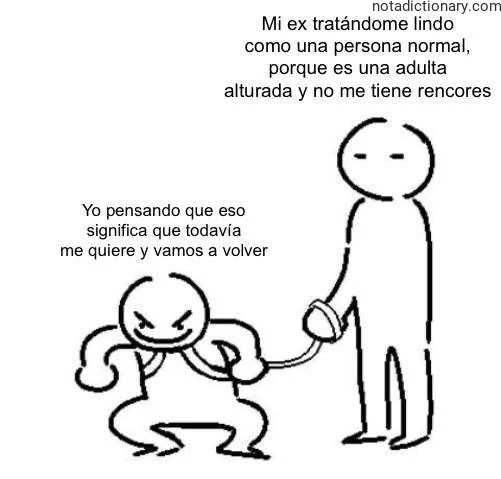
Mi ex tratandome lindo
→ “My ex is being nice to me”
Mi [wǒ de] — my (possessive pronoun)
tratandome [duì...hǎo] — treating me (literally: doing good to me) — 'tratar' means 'to treat', and '-ando' is the present participle form, while 'me' is the object pronoun for 'me'
lindo [hǎokàn de] — nice/pretty — often used to describe kind or affectionate behavior
notadictionary.com
porque es una adulta alturada
→ “because she's an older adult”
porque [yīnwèi] — because — a conjunction introducing a reason
es [shì] — is — the verb 'ser' in the third-person singular form
una adulta [chéngrén] — adult — specifically feminine form, referring to someone who is no longer a child
alturada [niánzhǎng de] — older — literally 'tallened,' but in this context, it's slang for 'older' or 'more mature'
notadictionary.com
y no me tiene rencores
→ “and doesn't hold grudges against me”
y [ér] — and — a coordinating conjunction connecting two ideas
no [bù] — not — negation particle
me [wǒ] — me (object pronoun)
tiene [yǒu] — has — from the verb 'tener' (to have), here meaning 'to hold' or 'to carry'
rencores [yuànchóu] — grudges/hatred — a strong feeling of resentment or anger toward someone
notadictionary.com
Yo pensando que eso significa
→ “Me thinking that that means”
Yo [wǒ] — I — subject pronoun
pensando [yǐwéi] — thinking — from the verb 'pensar' (to think), with the -ando ending indicating ongoing action
que [de] — that — introducing a subordinate clause
eso [nàge] — that — demonstrative pronoun pointing to something specific
significa [yìwèi] — means — from the verb 'significar' (to mean/signify)
notadictionary.com
que todavía me quiere y vamos a volver
→ “that she still likes me and we're going to get back together”
que [yīnwèi] — that — introducing a subordinate clause
todavía [hái] — still — emphasizing continuity or persistence
me [wǒ] — me (object pronoun)
quiere [xǐhuān] — likes/wants — from the verb 'querer' (to want/like), third-person singular form
y [ér] — and — coordinating conjunction
vamos [yào] — we're going — from the verb 'ir' (to go), first-person plural form
a [qù] — to — preposition indicating direction or purpose
volver [huílái] — get back/together again — from the verb 'volver' (to return)