

Analysis of Japanese Haiku for English learners. Line by line.
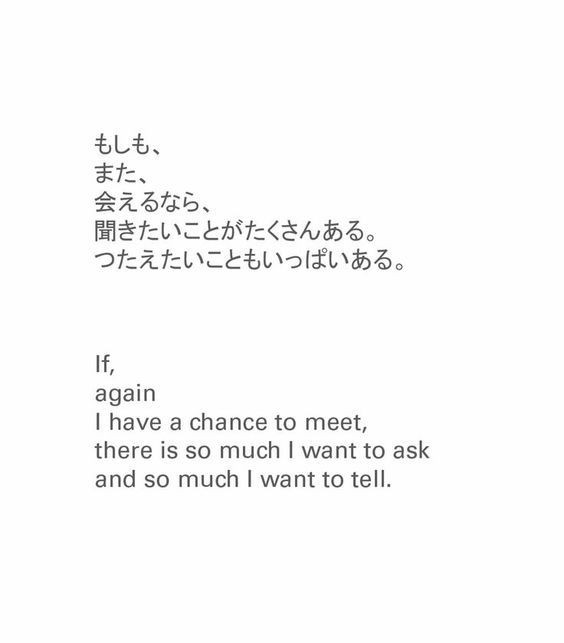
もしも、
また、
なら、
会えるなら、
聞きたいことがたくさんある。
伝えたいこともいっぱいある。
Moshimo,
mata,
tara, nara,
aeru nara,
kikitai koto ga takusan aru.
tsutaetai koto mo ippai aru.
If,
again,
in the case that,
if I can meet you again,
there are so many things I want to ask.
There are also so many things I want to tell/convey.
Line 1: もしも (moshimo)
→ adverb meaning “if” / “supposing” / “in case”
→ stronger and more emotional/dramatic than plain もし(moshi)
! often appears at the beginning of a long hypothetical wish
→ here: sets the tone of fragile, almost painful hope
Line 2:また (mata)
→ adverb = “again” / “once more” / “a second time”
→ shows repetition — the speaker misses a past meeting and wants it to happen again
→ very common in expressions of longing / nostalgia
Line 3: なら (nara)
→ conditional particle = “if it is the case that” / “provided that” / “in the situation where”
→ attaches to nouns, adjectives, or the dictionary form of verbs → here it stands alone because the previous words (もしも、また) already imply the topic
→ creates layered condition: “if it happens again, if that situation exists…”
Line 4: 会えるなら
会える (aeru)
→ potential form of verb 会う (au = to meet)
→ means “can meet” / “be able to meet” / “there is a possibility to meet”
→ rule: verb stem + える = potential (“can do”)
→ very important: not “will meet”, but “if it is possible to meet” → underlines rarity / difficulty
なら (nara)
→ “if”
! rule: なら attaches directly to the potential form → 会えるなら = “if I/we can meet”
Line 5: 聞きたいことがたくさんのある。
聞きたい (kikitai)
→ desiderative form: verb 聞く (kiku = hear/ask) + たい = “want to hear” / “want to ask”
→ rule: verb stem + たい = “I want to do…”
こと (koto)
→ nominalizer = turns the verb phrase into a noun → “things (that I want to ask)”
→ rule: 〜たいこと = “things I want to…”
が (ga)
→ subject particle
→ rule: marks 聞きたいこと as the subject of the verb ある (there are)
たくさん (takusan)
→ quantity word = “a lot” / “so many” / “lots”
の (no)
→ explanatory/possessive particle
→ rule: here = “of the many…” → connects たくさん to the following ある
ある (aru)
→ verb = “there is / there are / exist” (used for inanimate things)
→ whole line: “There are so many things I want to ask.”
Line 6: 伝えたいこともいっぱいある。
伝えたい (tsutaetai)
→ desiderative: 伝える (tsutaeru = convey/tell/express) + たい = “want to tell” / “want to convey”
こと (koto)
→ nominalizer → “things (that I want to tell)”
も (mo)
→ particle = “also” / “too” / “as well”
→ rule: adds “in addition to the previous thing” → refers back to 聞きたいこと
いっぱい (ippai)
→ quantity word = “a lot” / “plenty” / “full”
* more colloquial, warmer, more emotional than たくさん
feels vulnerable / childlike / heart-full
ある (aru)
→ “there are / exist”
Whole line: “There are also plenty of things I want to tell/convey.”
Wordlist from the Poem.
| Word (romaji) | Part of speech | Translation (feeling/nuance) | How to spell (Japanese script + pronunciation guide) |
|---|---|---|---|
| moshimo | conditional adverb | if / supposing (dramatic, unlikely, wishful longing) | もしも — “moh-shee-moh” (mo like “more”, shi like “she”, soft “oh” at end) |
| mata | adverb | again / once more (nostalgic repetition, yearning) | また — “mah-tah” (mah like “mama”, tah like “ta” in “star”) |
| nara | conditional particle | if it is the case / provided that (soft hypothetical) | なら — “nah-rah” (nah like “nah”, rah like “ra” in “car”) |
| aeru | potential verb form | can meet / be able to meet (fragile possibility, hope) | 会える — “ah-eh-roo” (ah like “father”, eh like “bed”, roo like “rue”) |
| kikitai | desiderative verb (たい-form) | want to ask / want to hear (urgent curiosity, need for answers) | 聞きたい — “kee-kee-tah-ee” (kee like “key”, tah like “ta”, ee like “see”) |
| koto | nominalizer noun | thing / matter (turns verb into “things to…”) | こと — “koh-toh” (koh like “coat”, toh like “toe”) |
| ga | subject particle | (marks subject; neutral) | が — “gah” (gah like “got” but softer g) |
| takusan | quantity adverb/noun | a lot / so many (abundant, overflowing emotion) | たくさん — “tah-koo-sahn” (tah like “ta”, koo like “cool”, sahn like “sun”) |
| no | possessive/explanatory particle | of / that are (connects quantity) | の — “noh” (noh like “no” in “no way”) |
| aru | existence verb | there is / there are (existence of inner feelings) | ある — “ah-roo” (ah like “father”, roo like “rue”) |
| tsutaetai | desiderative verb (たい-form) | want to tell / want to convey (strong need to express heart) | 伝えたい — “tsoo-tah-eh-tah-ee” (tsoo like “tsu” in “tsunami”, tah-eh like “ta” + “eh”, ee like “see”) |
| mo | additive particle | also / too (adds “as well”, builds emotional list) | も — “moh” (moh like “more” but shorter) |
| ippai | quantity adverb (colloquial) | plenty / a lot / full (warm, vulnerable, overflowing) | いっぱい — “eep-pie” (eep like “eep” sound, pie like “pie”) |