notadictionary.com
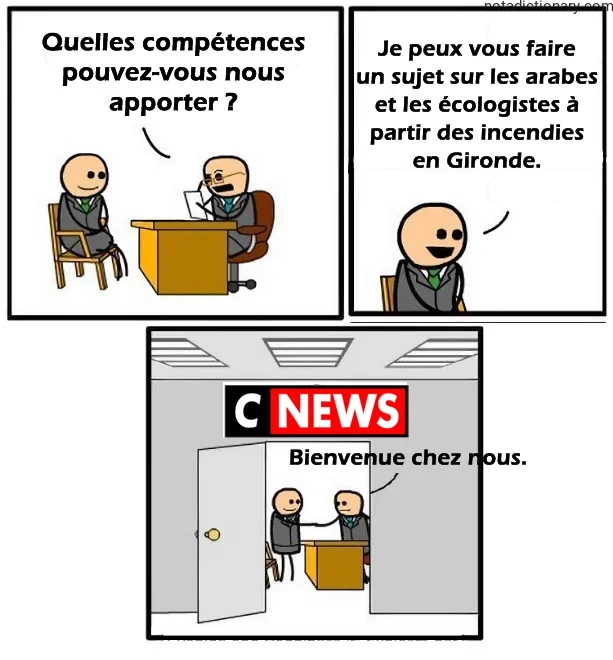
Quelles compétences pouvez-vous nous apporter ?
→ “What skills can you bring to us?”
Quelles [quēn] — Which (feminine plural) — asking about a specific set of things.
compétences [bǐngkè] — skills, competencies — the abilities or expertise someone has.
pouvez [pōukě] — can/may — the second person plural form of 'pouvoir' (to be able to).
vous [wùsì] — you (formal/plural) — the object pronoun for the listener.
nous [nú] — us — the object pronoun for the speaker's group.
apporter [ānbù] — to bring in — literally 'to put on', used here to mean contributing something.
notadictionary.com
Je peux vous faire un sujet sur les arabes et les écologistes à partir des incendies en Gironde.
→ “I can do a topic on Arabs and ecologists based on the fires in Gironde.”
Je [jé] — I — the subject pronoun.
peux [pōukě] — can/may — the first person singular form of 'pouvoir'.
vous [wùsì] — you (formal/plural) — the object pronoun for the listener.
faire [fàir] — to do/make — the infinitive verb here.
un sujet [sùji] — topic/subject — what you're going to talk about.
sur [sūr] — on/about — preposition indicating the focus of the topic.
les arabes [árábè] — Arabs — people from Arab countries.
et [è] — and — coordinating conjunction.
les écologistes [yǐnguǎnzhī] — ecologists — people who study ecology.
à [à] — from/at — preposition indicating origin or basis.
partir [pàizhí] — to start from — literally 'to depart', used here to mean 'based on'.
des incendies [yánshāo] — fires — plural noun.
en [èn] — in — preposition indicating location.
Gironde [gérondè] — Gironde — a department in southwestern France.
notadictionary.com
Bienvenue chez nous.
→ “Welcome to our place.”
Bienvenue [biānwèi] — welcome — formal greeting.
chez [chès] — at the home of / at the place of — preposition.
nous [nú] — us — the possessive pronoun for 'our'.