notadictionary.com
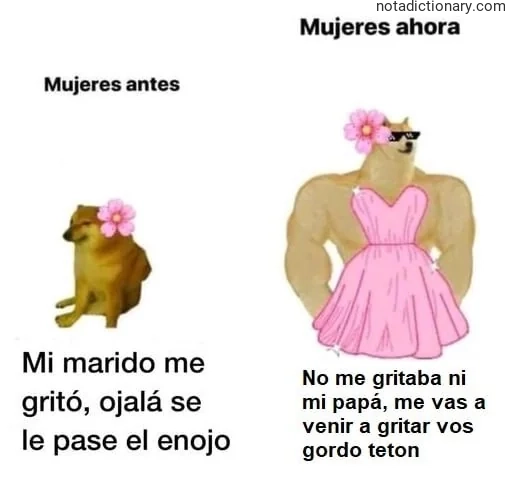
Mi marido me gritó, ojalá se le pase el enojo
→ “My husband yelled at me, I hope he gets over his anger.”
Mi [wǒ de] — my — possessive pronoun. 'Mi' literally means 'my', showing ownership.
marido [zhàngfū] — husband — a term for a married man. Literally 'man of marriage'.
me [wǒ] — me — direct object pronoun. It shows who receives the action of the verb.
gritó [hēng] — yelled — the past tense of 'gritar' (to yell/shout). The -ó ending shows it's a completed action in the past.
ojalá [wàngjì] — I hope / if only — an expression used to express a wish or desire. It literally means 'if God wills it'.
se [tā] — himself/herself — reflexive pronoun. It indicates that the action is directed back at the subject.
le pase [guòqù] — passes/gets over — from the verb 'pasar' (to pass). Here it means 'to get over' or 'to calm down'.
enojo [nùqì] — anger — a noun describing strong feelings of displeasure. Literally 'anger' or 'wrath'.
notadictionary.com
No me gritaba ni mi papá, me vas a venir a gritar vos gordo teton
→ “My dad never yelled at me, and you're coming to yell at ME, you fat cow.”
No [bù] — no — a negation word. It makes the sentence negative.
me [wǒ] — me — direct object pronoun. It shows who receives the action of the verb.
gritaba [hēng] — was yelling — the imperfect past tense of 'gritar' (to yell). It describes an ongoing action in the past.
ni [yě] — nor — a conjunction used to add another negative item. 'Ni' literally means 'neither' or 'nor'.
mi [wǒ de] — my — possessive pronoun. 'Mi' literally means 'my', showing ownership.
papá [dàdi] — dad — a term for a father. Literally 'big brother' but used affectionately for dad.
me [wǒ] — me — direct object pronoun. It shows who receives the action of the verb.
vas [yào] — are going — from the verb 'ir' (to go). 'Vas' is the second-person singular form.
a [qù] — to — preposition indicating direction or purpose. 'A' literally means 'to'.
venir [lái] — to come — an infinitive verb. It literally means 'to come'.
a [qù] — to — preposition indicating direction or purpose. 'A' literally means 'to'.
gritar [hēng] — to yell — an infinitive verb. It literally means 'to shout/yell.'
vos [nǐ] — you (informal, plural or familiar) — a pronoun used in some Spanish-speaking regions. 'Vos' literally means 'you'.
gordo [fénpàng] — fat — an adjective describing someone's physical appearance. Literally 'fat'.
teton [dàpí] — cow — a derogatory term for a woman, often used humorously or insultingly. Literally 'big udder'.