notadictionary.com
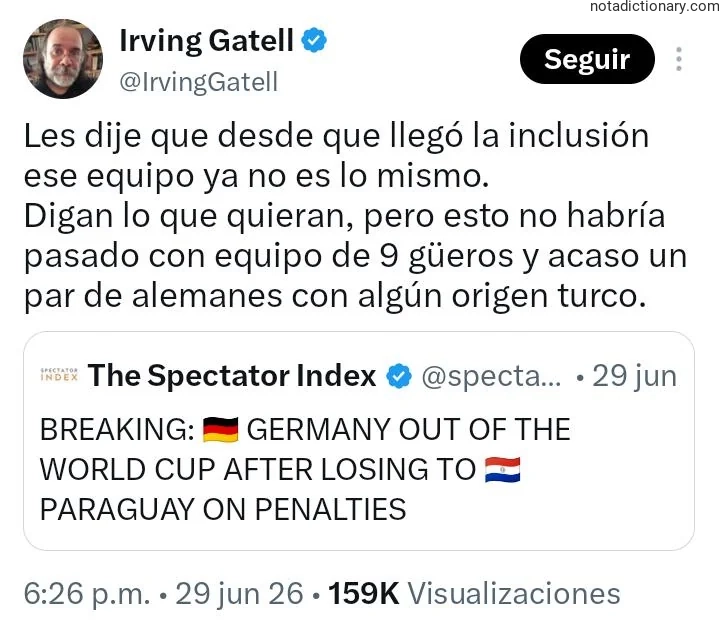
Les dije que desde que llegó la inclusión ese equipo ya no es lo mismo.
→ “I told them that since inclusion arrived, that team is not the same anymore.”
Les dije [díje] — I said/told (past tense of decir). The 'di' part means 'said', and '-je' is the first-person singular ending.
que — that. It introduces a clause, like a little bridge to connect two ideas.
desde — since. It marks the starting point of something in time.
que — that again. Another little bridge for the second idea.
llegó [llegó] — arrived/came. The past tense of llegar, meaning something entered or started happening.
la inclusión — inclusion. It's all about bringing people together who were left out before.
ese — that one over there. It points to a specific team we're talking about.
equipo — team. The group of players working together.
ya — already. It shows something has happened or changed before now.
no — not. It negates the verb, saying something isn't true.
es [és] — is (third-person singular). It links the subject to its description.
lo mismo — same. It emphasizes that nothing is unchanged.
notadictionary.com
Digan lo que quieran, pero esto no habría pasado con equipo de 9 güeros y acaso un par de alemanes con algún origen turco.
→ “Say whatever they want, but this wouldn't have happened with a team of 9 white guys and maybe a couple of Germans with some Turkish origin.”
Digan [dígan] — Let them say (imperative form of decir). It's like telling someone else to do the action.
lo que — that. Another little bridge, linking the main clause to the subordinate one.
quieran [quíeran] — want (subjunctive form). It shows uncertainty or a wish.
pero — but. It connects two contrasting ideas.
esto — this. It points to the situation we're talking about.
no — not. It negates the verb, saying something wouldn't happen.
habría [habría] — would have (conditional perfect). It talks about something that didn't happen in the past.
pasado [pasado] — happened. It's the past participle of pasar, meaning something occurred.
con — with. It shows association or accompaniment.
equipo — team. The group of players we're imagining.
de — of. It shows possession or origin.
9 — nine. The number of players we're talking about.
güeros — white guys. A colloquial term for people with light skin.
y — and. It connects two things together.
acaso — maybe/maybe even. It shows uncertainty or possibility.
un par — pair. Two of something, like a couple.
de — of. Again, showing possession or origin.
alemanes — Germans. People from Germany.
con — with. Showing association again.
algún — some. It refers to an unspecified amount or type.
origen — origin. Where something comes from.
turco — Turkish. Related to Turkey or Turkish people.