PHRASES
notadictionary.com
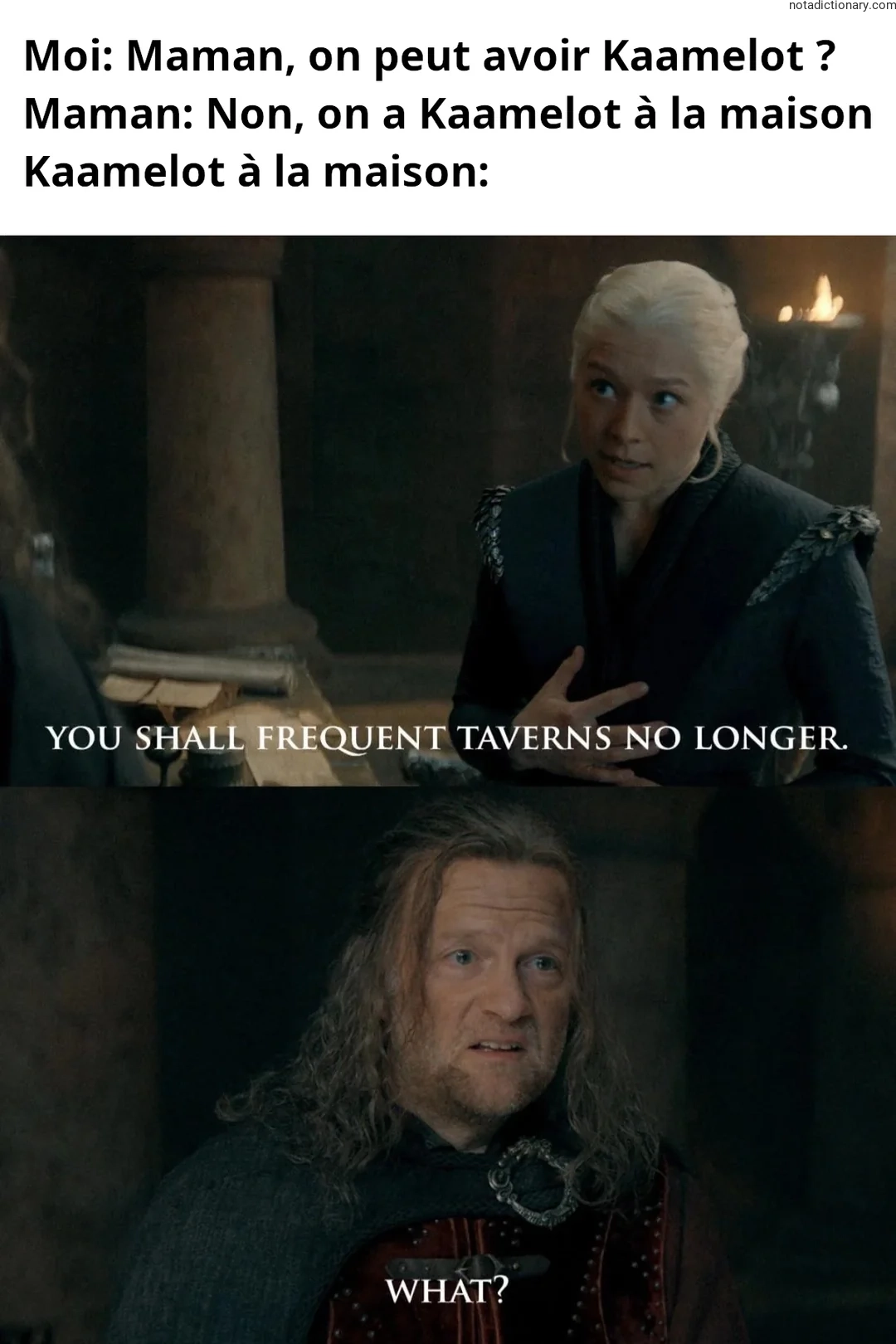
Moi: Maman, on peut avoir Kaamelot ?
→ “Me: Mom, can we have Camelot?”
Moi [wǒ] — I/me — the speaker identifying themselves.
Maman [māmān] — Mom — affectionate term for mother.
on [on] — we/one — a common French way to say 'we' or 'one' in general statements.
peut [kěyǐ] — can/may — a polite way to ask for permission.
avoir [yǒu] — to have — here it's used idiomatically to mean 'to get' or 'to enjoy'.
Kaamelot — Camelot — a fictional place from Arthurian legend, humorously misspelled as 'Kaamelot'.
notadictionary.com
Maman: Non, on a Kaamelot à la maison
→ “Mom: No, we already have Camelot at home.”
Non [bù] — No — a direct negation.
on [on] — we/one — same as before, casual impersonal pronoun.
a [yǒu] — has/have — present tense of 'avoir' (to have).
à [dào] — at/to — preposition indicating location.
la maison [jiā] — house/home — literal translation is 'home', but contextually 'house'.
notadictionary.com
Kaamelot à la maison:
→ “Camelot at home:”
Kaamelot — Camelot — again, the fictional place, misspelled humorously.
à [dào] — at/to — preposition.
la maison [jiā] — house/home — contextually 'house'.
notadictionary.com
YOU SHALL FREQUENT TAVERNS NO LONGER.
→ “You are forbidden from visiting taverns anymore.”
YOU — you — direct address to the person being spoken to.
SHALL — will/shall — an archaic form of 'will', used here for dramatic effect.
FREQUENT — visit/frequent — to regularly go to a place.
TAVERNS — taverns — places where people gather to drink and socialize.
NO — not/anymore — emphasizes the finality of the prohibition.
LONGER — anymore — indicates that something is no longer happening.
notadictionary.com
WHAT?
→ “What?/Huh?”
WHAT — what — an expression of surprise or confusion.