notadictionary.com
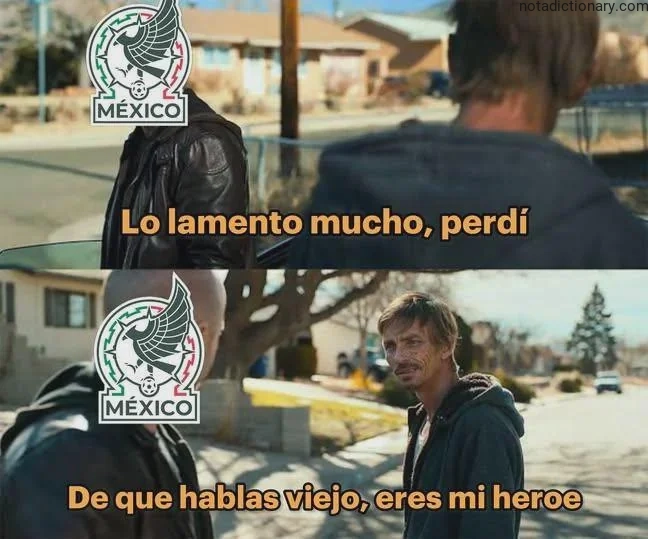
Lo lamento mucho, perdí
→ “I'm so sorry, I lost.”
lo lamento [lamento] — to regret or feel sorry. It comes from the verb 'lamentar,' which literally means 'to mourn' or 'to grieve.'
mucho [mucho] — very much — emphasizes how deeply sorry the speaker feels.
perdí [perdí] — I lost. The verb 'perder' means 'to lose,' and 'perdí' is the first-person singular past tense.
notadictionary.com
De que hablas viejo, eres mi héroe
→ “What are you talking about, old man? You're my hero.”
de [de] — of/from — here it's part of the phrase 'de qué hablas,' meaning 'what are you talking about?'
que [que] — that/what — used in questions to ask 'what' something is.
hablas [hablas] — you talk. 'Hablar' means 'to speak,' and 'hablas' is the second-person singular present tense.
viejo [viejo] — old man — a casual, slightly informal way to address someone older or as a term of endearment.
eres [eres] — you are. 'Eres' is the second-person singular form of the verb 'ser,' which means 'to be.'
mi [mi] — my — possessive pronoun showing ownership.
héroe [héroe] — hero — a person admired for their courage, outstanding achievements, or noble qualities.