PHRASES
notadictionary.com
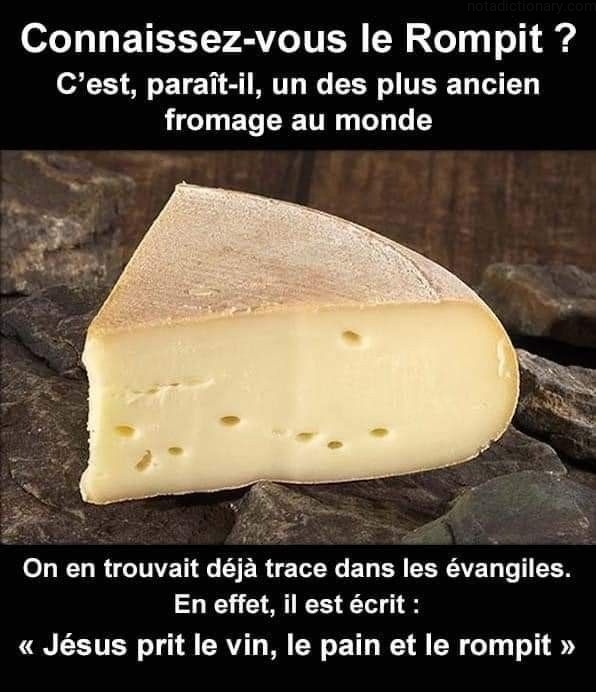
Connaissez-vous le Rompit ?
→ “Do you know the Rompit?”
Connaissez-vous — know — do you know; present tense, 2nd-person plural of connaître
le Rompit — the Rompit → proper noun referring to a specific cheese name
notadictionary.com
C'est, paraît-il, un des plus ancien fromage au monde
→ “It is, it seems, one of the oldest cheeses in the world”
C'est — it is
paraît-il — it seems / apparently (literally 'it appears that')
un des plus ancien fromage — one of the oldest cheeses → note: 'plus ancien' should agree with 'fromage' (masculine), so technically it's 'plus anciens' but here it's used as an adjective phrase modifying 'fromage'
au monde — in the world → contraction of 'à + le monde'
notadictionary.com
On en trouvait déjà trace dans les évangiles.
→ “We already found traces of it in the Gospels.”
On — we / people / one
en — of it / some of it → pronoun replacing 'du rompit' or similar
trouvait — found → imperfect tense, 3rd-person singular of trouver
déjà — already
trace — trace / evidence
dans — in
les évangiles — the Gospels → plural noun referring to the biblical texts
notadictionary.com
En effet, il est écrit :
→ “Indeed, it is written:”
En effet — indeed / in fact
il est écrit — it is written → passive construction using être + past participle
notadictionary.com
« Jésus prit le vin, le pain et le rompît »
→ “"Jesus took the wine, the bread, and the rompit"”
Jésus — Jesus → proper noun
prit — took → past historic tense, 3rd-person singular of prendre
le vin — the wine
le pain — the bread
et — and
le rompît — the rompit → past historic tense, 3rd-person singular of rompre (archaic/literary form)