Learn Spanish With Memes: Olvidar Lo Que Vi

Forgot my dreams, now what?
Let’s go over the rules…
Use tall when something is measured from its bottom to its top, especially when its height is noticeably greater than its width. It’s sitting on a surface or the ground!
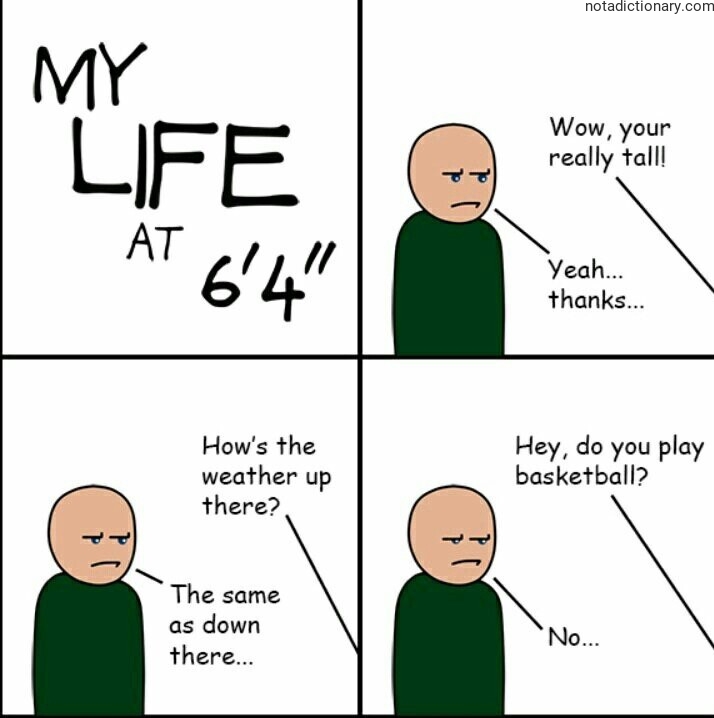
Use high when something is situated far above the ground/sea level, or when measuring distance off the floor. It doesn’t matter if it’s narrow or wide!
Ex.
➖ Check out that plane high in the sky! (It’s elevated in space, not standing on feet!)
➖ The room has high ceilings. (Distance from floor to top is large!)
Everest vs. Mauna Kea: Height Paradox 🌋
Did you know? Mount Everest is officially the HIGHEST mountain on Earth because its peak reaches 8,848 meters above sea level. But Hawaii’s Mauna Kea is technically the TALLEST mountain in the world—measuring over 10,000 meters from its underwater ocean base to its peak! 🌊 flex.
Did you know?
Towering is not just about raw physical feet or meters—it’s an emotional gut-punch! Use towering when something is so overwhelmingly tall or impressive that it casts a shadow over everything else around it.
A guy walked into a high-end rooftop lounge in Dubai and asked the bartender:
“Excuse me, is this building high or tall?”
The bartender blinked and said: “Sir, the building is tall, the floor is high, and after two of our $30 cocktails, you will be both.” 🍸💸
Today we gonna break it down once and for all 🧹📋
Both are pieces of work you have to do. But their vibe, life cycle, and emotional damage couldn’t be more different…
🚩🚩 Use TASK when you’re talking about a specific, finite piece of work assigned to you or self-imposed to reach a goal. It usually has a deadline, a clear beginning and end, and once it’s done, you get that sweet hit of dopamine.
➖ Complete the Q3 budget report before 5 PM.
➖ Install the new software update on your laptop.
🚩🚩 Use CHORE when referring to routine, repetitive, and usually tedious maintenance work – especially household duties or administrative upkeep. Chores never truly end; they just wait in the shadows until you drop your guard.
➖ Washing the one pan that’s been soaking in the sink since Tuesday.
➖ Taking out the trash before it starts developing its own ecosystem.
Dictionary says a chore can also mean any tedious or unpleasant task. So if your boss gives you a “task” to format 500 rows of an Excel sheet manually every single morning… congrats, your task just evolved into a soul-crushing chore. 🤷🏻♂️⚡️🙄
To put it simple: 🏆 Task: You finish it, cross it off your to-do list, and feel like a legend.
🧹 Chore: You finish it, and your reward is having to do it again in 24 hours.
Now go clear your sink so you can go back to being productive! 🧽✨