PHRASES
notadictionary.com
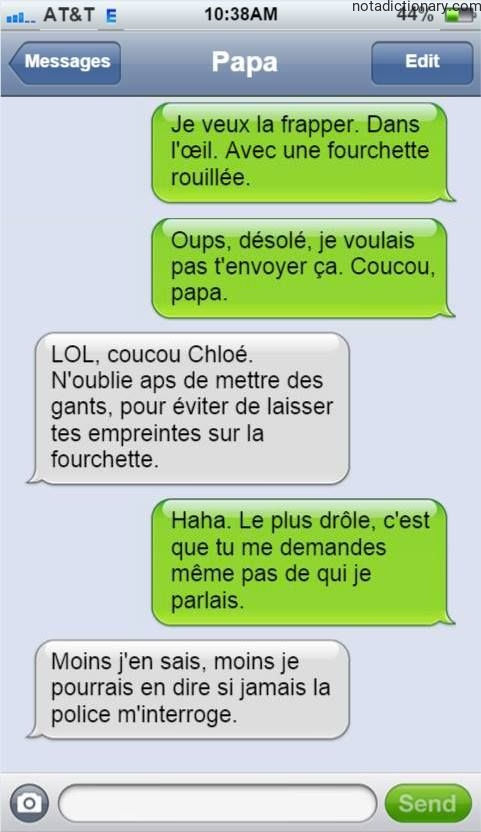
Je veux la frapper. Dans l'œil. Avec une fourchette rouillée.
→ “I want to hit her. In the eye. With a rusty fork.”
Je — I (subject pronoun)
veux — want — present tense, 1st-p. singular of vouloir
la frapper — to hit / strike (infinitive verb)
Dans — in / into (preposition)
l'œil — the eye → contracted form of 'le œil', used before vowel sounds
Avec — with (preposition)
une fourchette — fork (noun)
rouillée — rusty (past participle used as adjective, agrees with feminine noun)
notadictionary.com
Oups, désolé, je voulais pas t'envoyer ça. Coucou, papa.
→ “Oops, sorry, I didn't mean to send you that. Hi, dad.”
Oups — oops (interjection expressing mistake)
désolé — sorry (masculine adjective; implied subject is 'je')
je — I (subject pronoun)
voulais — wanted — imperfect tense, 1st-p. singular of vouloir
pas — not (part of negation with 'ne') → here dropped in informal speech
t' — you (object pronoun, elided before vowel) → from 'te'
envoyer — to send (infinitive verb)
ça — that (demonstrative pronoun, colloquial)
Coucou — hi / hey (informal greeting, often playful or teasing)
papa — dad (noun, affectionate address)
notadictionary.com
LOL, coucou Chloé. N'oublie aps de mettre des gants, pour éviter de laisser tes empreintes sur la fourchette.
→ “LOL, hi Chloe. Don't forget to wear gloves, to avoid leaving your fingerprints on the fork.”
LOL — lol (acronym for 'laugh out loud', borrowed from English internet slang)
coucou — hi / hey (informal greeting)
Chloé — Chloe (proper noun, name)
N'oublie — don't forget — imperative form of 'oublier', negative with elided 'ne'
aps — forget → colloquial spelling of 'pas', informal drop of 'ne' in spoken French
de — to / of (preposition introducing infinitive)
mettre — to put / to wear (infinitive verb)
des gants — gloves (plural noun)
pour — for / to (preposition indicating purpose)
éviter — to avoid (infinitive verb)
de — of / to (preposition introducing infinitive after 'éviter')
laisser — to leave (infinitive verb)
tes — your (possessive adjective, plural informal)
empreintes — fingerprints / imprints (plural noun)
sur — on / upon (preposition)
la fourchette — fork (noun)
notadictionary.com
Haha. Le plus drôle, c'est que tu me demandes même pas de qui je parlais.
→ “Haha. The funniest part is that you don't even ask me who I was talking about.”
Haha — haha (interjection expressing laughter)
Le plus — most / more (adverb modifying superlative)
drôle — funny / amusing (adjective)
c'est — it is — contraction of 'ce est', used to introduce definition or emphasis
que — that (conjunction introducing subordinate clause)
tu — you (informal singular subject pronoun)
me — me (indirect object pronoun)
demandes — ask — present tense, 2nd-p. singular of demander
même — even / still (adverb emphasizing degree)
pas — not (part of negation with 'ne') → here dropped in informal speech
de — of / about (preposition introducing question word)
qui — who (interrogative pronoun)
je — I (subject pronoun)
parlais — was talking — imperfect tense, 1st-p. singular of parler
notadictionary.com
Moins j'en sais, moins je pourrais en dire si jamais la police m'interroge.
→ “The less I know, the less I could say if ever the police interrogate me.”
Moins — less (adverb, comparative)
j' — I (subject pronoun, elided before vowel) → from 'je'
en — of it / some of it (pronoun replacing previously mentioned thing)
sais — know — present tense, 1st-p. singular of savoir
moins — less (adverb, comparative)
je — I (subject pronoun)
pourrais — could — conditional tense, 1st-p. singular of pouvoir
en — about it / of it (pronoun replacing previously mentioned thing)
dire — to say / to tell (infinitive verb)
si — if (conjunction introducing condition)
jamais — ever / never (adverb, here meaning 'if ever')
la police — police (noun, invariant plural form)
m' — me (object pronoun, elided before vowel) → from 'me'
interroge — interrogate — present tense, 3rd-p. singular of interroger