PHRASES
notadictionary.com
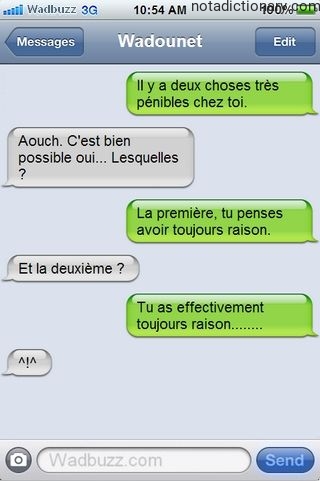
Il y a deux choses très pénibles chez toi.
→ “There are two very annoying things about you.”
Il y — there — indicates existence/location (clitic particle)
a — has — present tense, 3rd-p. singular of avoir (to have)
deux — two — cardinal number
choses — things — plural noun
très — very — intensifying adverb
pénibles — annoying — adjective; plural form agreeing with 'choses'
chez — at/in the house of — preposition indicating location or association
toi — you — informal singular object pronoun
notadictionary.com
Aouch. C'est bien possible oui... Lesquelles ?
→ “Ouch. That's quite possible, yes... Which ones?”
Aouch — Ouch — interjection expressing pain or surprise
C' — it is — contraction of 'ce' + 'est'
est — is — present tense, 3rd-p. singular of être (to be)
bien — quite — intensifying adverb modifying 'possible'
possible — possible — adjective
oui — yes — affirmative adverb
Lesquelles — which ones — feminine plural interrogative pronoun
notadictionary.com
La première, tu penses avoir toujours raison.
→ “The first one: you think you're always right.”
La première — first — ordinal adjective; feminine singular form
tu — you — informal singular subject pronoun
penses — think — present tense, 2nd-p. singular of penser (to think)
avoir — to have — infinitive verb
toujours — always — adverb
raison — reason — here means 'being right'; feminine singular noun
notadictionary.com
Et la deuxième ?
→ “And the second one?”
Et — and — coordinating conjunction
la deuxième — second — ordinal adjective; feminine singular form
notadictionary.com
Tu as effectivement toujours raison........
→ “You do indeed always have reason.........”
Tu — you — informal singular subject pronoun
as — have — present tense, 2nd-p. singular of avoir (to have)
effectivement — indeed — emphatic adverb
toujours — always — adverb
raison — reason — here means 'being right'; feminine singular noun