notadictionary.com
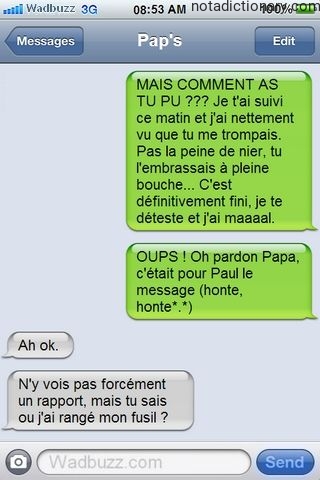
MAIS COMMENT AS TU PU ??? Je t'ai suivi ce matin et j'ai nettement vu que tu me trompais. Pas la peine de nier, tu l'embrassais à pleine bouche... C'est définitivement fini, je te déteste et j'ai maaaal.
→ “But how could you??? I followed you this morning and clearly saw that you were cheating on me. No point in denying it, you were kissing him/her with your mouth full... It's definitely over, I hate you and I'm sooo angry.”
MAIS — but → conjunction linking two contrasting ideas
COMMENT — how → interrogative adverb asking about manner or method
AS — could (past tense of 'pouvoir') → auxiliary verb for ability/possibility
TU — you (informal singular pronoun) → subject of the verb 'pu'
PU — done (past participle of 'pouvoir') → shows completed action; present tense, 2nd-p. singular of pouvoir
Je — I → subject pronoun; present tense, 1st-p. singular of 'avoir'
t'ai — have (contraction of 'te ai') → direct object pronoun + auxiliary verb; present tense, 1st-p. singular of 'avoir'
suivi — followed → past participle of 'suivre'; indicates completed action
ce — this → demonstrative adjective modifying 'matin'
matin — morning → noun indicating time of day
et — and → coordinating conjunction joining two clauses
j'ai — I have (contraction of 'je ai') → subject + auxiliary verb; present tense, 1st-p. singular of 'avoir'
nettement — clearly → adverb modifying 'vu', emphasizing visibility
vu — seen → past participle of 'voir'; indicates completed perception
que — that → subordinating conjunction introducing a clause
tu — you (informal singular pronoun) → subject of 'trompais'
me — me → reflexive/direct object pronoun referring to speaker
trompais — were cheating (imperfect tense of 'tromper') → ongoing past action; imperfect tense, 2nd-p. singular of 'tromper'
Pas — not → negation particle; informal spoken form dropping 'ne'
la peine — trouble/pain → noun meaning effort or suffering; part of idiom 'pas la peine de'
de — of → preposition introducing infinitive verb 'nier'
nier — to deny → infinitive verb following preposition 'de'
tu — you (informal singular pronoun) → subject of 'embrassais'
l'embrassais — you were kissing him/her (imperfect tense of 'embrasser') → ongoing past action; imperfect tense, 2nd-p. singular of 'embrasser'
à — with → preposition indicating means or manner
pleine — full → adjective agreeing with 'bouche' in gender/number
bouche — mouth → noun indicating body part; feminine singular
C'est — it is (contraction of 'ce est') → subject + verb; present tense, 3rd-p. singular of 'être'
définitivement — definitely → adverb emphasizing finality of statement
fini — over → adjective describing state of relationship; agrees with implied subject 'c'est'
je — I → subject pronoun; present tense, 1st-p. singular of 'détester'
te — you (informal singular object pronoun) → direct object of 'déteste'
déteste — hate (present tense of 'détester') → expresses strong emotion; present tense, 1st-p. singular of 'détester'
et — and → coordinating conjunction joining two verbs
j'ai — I have (contraction of 'je ai') → subject + auxiliary verb; present tense, 1st-p. singular of 'avoir'
maaiaal — sooo angry (colloquial intensifier of 'mal') → informal expression showing extreme emotion; derived from 'mal' with elongated vowel for emphasis
notadictionary.com
OUPS ! Oh pardon Papa, c'était pour Paul le message (honte, honte*.*)
→ “OOPS! Oh sorry Dad, the message was for Paul (shame, shame *.* )”
OUPS — oops → interjection expressing sudden realization or mistake
Oh — oh → interjection expressing surprise or apology
pardon — sorry/excuse → noun used as apology expression
Papa — dad → noun of address; informal term for father
c'était — it was (contraction of 'ce était') → subject + verb; imperfect tense, 3rd-p. singular of 'être'
pour — for → preposition indicating recipient or purpose
Paul — Paul → proper noun; name of person message intended for
le message — message → noun indicating communication; masculine singular
(honte, — shame → noun expressing embarrassment; first item in parenthetical list
honte*.*) — shame *.* → repeated noun with emoticon showing intensified shame; asterisks represent blushing face emoji
notadictionary.com
N'y vois pas forcément un rapport, mais tu sais où j'ai rangé mon fusil ?
→ “You don't necessarily see a connection there, but do you know where I put my gun?”
N'y — there/to it (contraction of 'ne y') → pronominal adverb replacing location mentioned earlier; formal negation drops 'ne' in speech
vois — see (present tense of 'voir') → main verb expressing perception; present tense, 2nd-p. singular of 'voir'
pas — not → negation particle; informal spoken form dropping 'ne'
forcément — necessarily → adverb modifying 'vois', indicating certainty level
un rapport — connection/link → noun indicating relationship between things; masculine singular
mais — but → coordinating conjunction introducing contrasting idea
tu — you (informal singular pronoun) → subject of 'sais'
sais — know (present tense of 'savoir') → main verb expressing knowledge; present tense, 2nd-p. singular of 'savoir'
où — where → interrogative/adverbial adverb introducing place clause
j'ai — I have (contraction of 'je ai') → subject + auxiliary verb; present tense, 1st-p. singular of 'avoir'
rangé — put away (past participle of 'ranger') → indicates completed action of storing
mon — my → possessive adjective agreeing with 'fusil' in gender/number
fusil — gun → noun indicating weapon; masculine singular; metaphorical threat in context