notadictionary.com
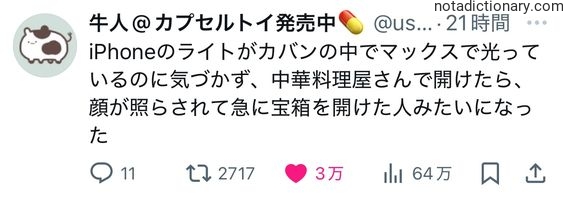
iPhoneのライトがカバンの中でマックスで光っているのに気づかず、中華料理屋さんで開けたら、顔が照らされて急に宝箱を開けた人みたいになった
→ “Not realizing the iPhone's flashlight was on max brightness inside my bag, I opened it at a Chinese restaurant and suddenly felt like someone who had just opened a treasure chest with their face lit up.”
iPhone = iPhone (noun) - brand name of smartphone
の no = possessive particle 'of' (nouns)
ライト raito = light / lamp (loanword from English)
が ga = subject marker particle (marks subject)
カバン kaban = bag / purse (noun)
の no = possessive particle 'of' (nouns)
中 chū¹ = middle / inside (suffix indicating state)
で de = location particle 'at/in' (for static location)
マックス makkkusu = maximum / max (loanword from English)
で de = manner particle 'with/by' (indicates means/manner)
光 hikari = to shine / light (verb stem)
って = colloquial contraction of 'ている' (indicating continuous action/state)
いる iru = to be (existential verb for animate objects)
の no = nominalizer turning clause into noun phrase
気づか kizuka = to notice / realize (stem form before negative)
気 ki = mind / feeling
づ zu = to perceive / detect
ず zu = negative connective 'without doing' (older/literary style)
、 = comma punctuation
中華 chū¹ka = Chinese (adjective/noun)
中 chū¹ = middle / center
華 ka = flower / splendor
料理 ryōr¹i = cooking / cuisine (noun)
料 ryō¹ = material / ingredient
理 ri = reason / principle
屋 ya = shop / establishment suffix
さん san = honorific title '-san'
で de = location particle 'at/in' (for actions)
開け ake = to open (imperative/stem form)
開 akai = open
け ke = causative/active suffix
たら tara = conditional 'if/when' (past tense condition)
、 = comma punctuation
顔 kao = face (noun)
が ga = subject marker particle (marks subject)
照 terashi = to illuminate / to shine on (causative/passive stem)
ら ra = causative/passive auxiliary marker
さ sa = causative/passive auxiliary marker
れ re = causative/passive auxiliary marker
て te = connective particle 'and' / gerund form
急 kyuu = suddenly / quickly (adverb stem)
に ni = directional particle 'to/towards' or manner marker
宝 takara = treasure (noun)
箱 hako = box (noun)
を o = direct object marker particle
開 ake = to open (verb stem)
け ke = causative/active suffix
た ta = past tense auxiliary verb
人 hito = person (noun)
み mi = like / resembling (na-adjektivizer)
たい tai = seems like / appears to be (desire-like adjective ending)
な na = copula 'to be' in colloquial negative form
っ = intensive consonant doubling (gemination)
た ta = past tense auxiliary verb