notadictionary.com
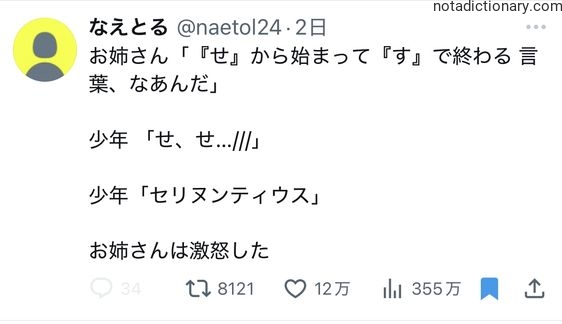
お姉さん「『セ』から始まって『ス』で終わる言葉、なあんだ」
→ “Big sister: "What's that word starting with 'Se' and ending with 'Su'?"”
お姉さん oneesan = big sister (noun)
「 = opening quotation mark (punctuation)
『 = double angle bracket opening (punctuation)
セ se = Se (letter/syllable)
」 = closing double angle bracket (punctuation)
から kara = from (particle indicating origin/source)
始まって hatimatte = starts (verb, te-form of hajimeru, informal)
始 ha = begin
始 me = begin
ま ma = prefix for causative/resultative
って tte = te-form connector (colloquial contraction)
『 = double angle bracket opening (punctuation)
ス su = Su (letter/syllable)
」 = closing double angle bracket (punctuation)
で de = by/at/from (particle indicating means/point of termination)
終わる owaru = to end (verb)
終 o = end
終 wa = end
る ru = verb ending (godan verb)
言葉 kotoba = word/language (noun)
言 ko = say
葉 ba = leaf
、 = comma (punctuation)
なあんだ naanda = what is it? (colloquial contraction of nani da na)
何 na = what
ん n = emphatic/nominalizer particle
だ da = is (copula)
」 = closing double angle bracket (punctuation)
notadictionary.com
少年「せ、せ...///」
→ “Boy: "Se, se...///"”
少年 shounen = boy/youth (noun)
少 shou = few/little
年 nen = year/age
「 = opening quotation mark (punctuation)
せ se = Se (kana syllable)
、 = comma (punctuation)
せ se = Se (kana syllable)
... = ellipsis (punctuation)
/// = sound effect symbol for stuttering (punctuation)
」 = closing quotation mark (punctuation)
notadictionary.com
少年「セリヌンティウス」
→ “Boy: "Serinusius"”
少年 shounen = boy/youth (noun)
少 shou = few/little
年 nen = year/age
「 = opening quotation mark (punctuation)
セ se = Se (kana syllable)
リ ri = Ri (kana syllable)
ヌ nu = Nu (kana syllable)
ン n = N (kana syllable, nasal sound)
テ te = Te (kana syllable)
イ i = I (kana syllable)
ウ u = U (kana syllable)
ス su = Su (kana syllable)
」 = closing quotation mark (punctuation)
notadictionary.com
お姉さんは激怒した
→ “The big sister got furious.”
お姉さん oneesan = big sister (noun)
は wa = wa (topic marker particle)
激怒 gekido = furious/infuriated (noun/adjective stem)
激 geki = intense/violent
怒 do = anger/rage
した shita = did/was (past tense of suru)
し shi = do/make
た ta = past tense marker