PHRASES
notadictionary.com
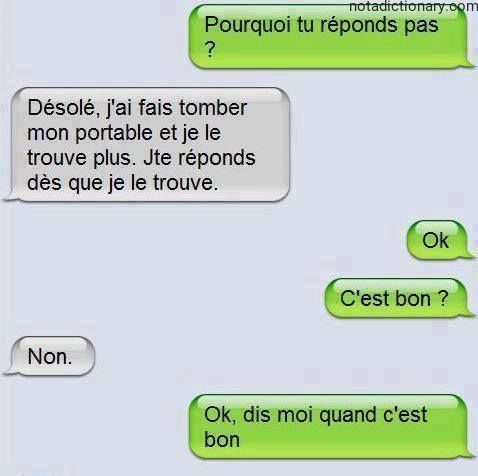
Pourquoi tu réponds pas ?
→ “Why aren't you replying?”
Pourquoi — why (interrogative adverb)
tu — you (informal singular subject pronoun)
réponds — reply (present tense, 2nd-person singular of répondre)
pas — not (part of spoken negation; formal 'ne...pas' becomes 'pas' alone in casual speech)
notadictionary.com
Désolé, j'ai fais tomber mon portable et je le trouve plus. Jte réponds dès que je le trouve.
→ “Sorry, I dropped my phone and can't find it anymore. I'll reply to you as soon as I find it.”
Désolé — sorry (masculine adjective used as an interjection/exclamation)
j' — I (contraction of 'je' before a vowel sound)
ai fais — made / caused (present tense, 1st-person singular of faire; here part of the idiom 'faire tomber')
tomber — fall (infinitive verb; combined with 'faire' to mean 'to drop')
mon — my (possessive adjective, masculine singular)
portable — phone (colloquial term for mobile phone)
et — and (coordinating conjunction)
je — I (subject pronoun)
le trouve — find (present tense, 1st-person singular of trouver)
plus — anymore / no longer (indicates cessation of an action or state)
Jte — I'll reply to you (colloquial contraction of 'Je te'; informal spoken French)
réponds — reply (present tense, 2nd-person singular of répondre; future sense implied by context)
dès — as soon as (preposition introducing time clause)
que — that / when (conjunction linking time clause)
je — I (subject pronoun)
le trouve — find (present tense, 1st-person singular of trouver)
notadictionary.com
Ok
→ “Okay”
Ok — okay (international loanword used in French)
notadictionary.com
C'est bon ?
→ “Is it good? / All set?”
C' — it is (contraction of 'ce est' before a vowel sound)
est — is (present tense, 3rd-person singular of être)
bon — good (adjective; here used colloquially to mean 'all right' or 'ready')
notadictionary.com
Non.
→ “No.”
Non — no (negative adverb)
notadictionary.com
Ok, dis moi quand c'est bon
→ “Okay, tell me when it's good / when you're ready.”
Ok — okay (international loanword used in French)
dis — tell (imperative mood, 2nd-person singular of dire)
moi — me (object pronoun)
quand — when (interrogative/adverbial conjunction introducing time clause)
c'est — it is (contraction of 'ce est')
bon — good (adjective; here used colloquially to mean 'ready' or 'suitable')