notadictionary.com
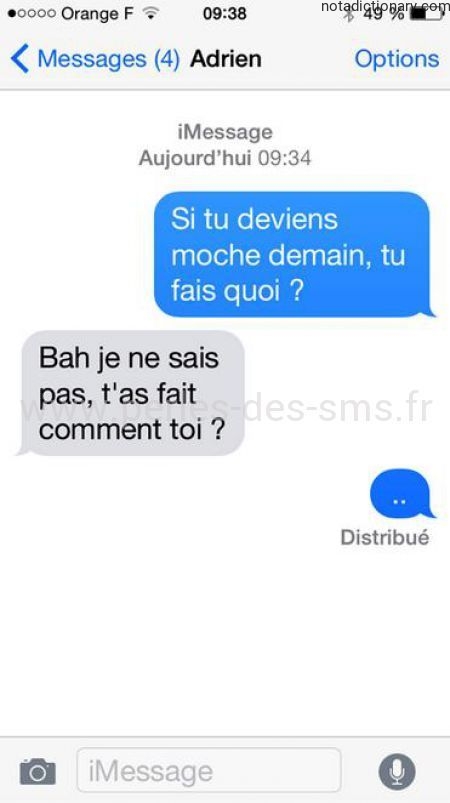
Si tu deviens moche demain, tu fais quoi ?
→ “What if you get ugly tomorrow, what do you do?”
Si — if → introduces a conditional clause
tu — you (informal singular pronoun)
deviens — get / become → present tense, 2nd-person singular of devenir; here it means 'to turn into' or 'become'
moche — ugly → colloquial adjective for unattractive
demain — tomorrow
tu — you (informal singular pronoun)
fais — do → present tense, 2nd-person singular of faire; in this context, it's part of the question 'what do you do?'
quoi — what → used at the end of questions to mean 'what' or 'which one'
notadictionary.com
Bah je ne sais pas, t'as fait comment toi ?
→ “Well, I don't know, how did you do it?”
Bah — well → colloquial filler word used to start a response
je — I → subject pronoun
ne — not → part of negation structure with 'pas'
sais — know → present tense, 1st-person singular of savoir; here it means 'to know' or 'to be aware of'
pas — not → completes the negation with 'ne' to mean 'don't'
t' — you have → contraction of 'te' + 'as'; informal way to say 'you have done'
as — have → present tense, 2nd-person singular of avoir; here it forms part of the passé composé construction
fait — done → past participle of faire; used with 'avoir' to form the passé composé
comment — how → adverb asking about manner or method
toi — you (emphatic form) → used for emphasis or contrast