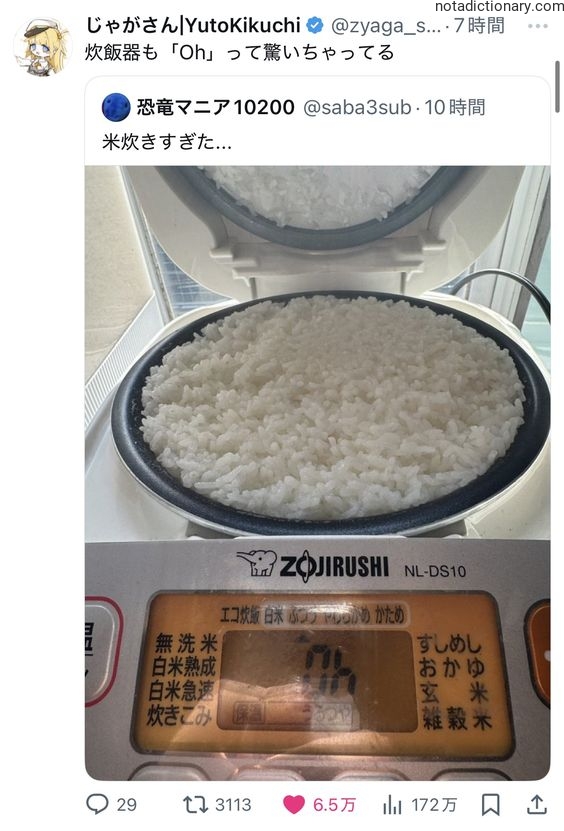
ってるter-u= is in a state of (colloquial form of -te iru, present continuous)
notadictionary.com
米炊きすぎた...
→ “Cooked the rice too much...”
米kome= rice (noun)
炊きtaki= cooking / steaming (verb stem)
すぎsugi= too much / excessive (suffix indicating excess)
たta= past tense marker (indicating the action is finished)
...= ellipsis (indicates trailing off or lingering feeling)
📐 GRAMMAR ANALYSIS
notadictionary.com
📌 Verb Contraction: ~ちゃう (chau) & ~てる (teru)
In Japanese, ちゃう (chau) is a colloquial contraction of しまう (shimau), often used to express an accidental or involuntary action. When combined with the progressive aspect ている (te iru), it becomes ちゃってる (chatteru). This specific structure implies that the action happened unintentionally and the result is still visible now.
Example: “驚いちゃってる (surprisedaccidentallyand is still)”
notadictionary.com
📌 Excessive Suffix: ~すぎる (sugiru)
The suffix すぎる (sugiru) attaches to the stem of a verb to mean 'to do something to an excessive degree.' In this meme, 米 (kome, rice) + 炊き (taki, cook) + すぎ (sugi) literally means 'cooked-too-much,' implying the rice is overcooked.