notadictionary.com
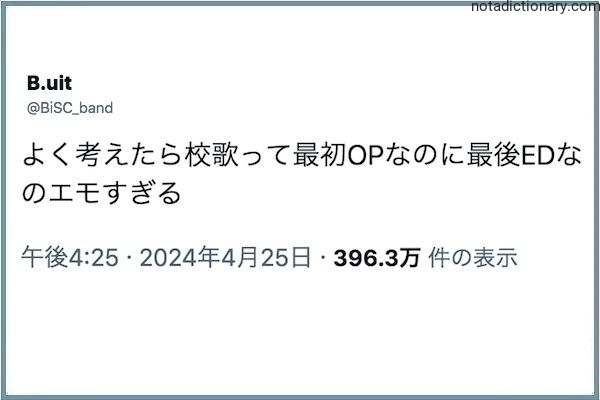
よく考えたら校歌って最初OPなのに最後EDなのエモすぎる
→ “When you really think about it, school songs are supposed to be the opening (OP), but they end up being the ending (ED) — that's way too emotional.”
よく yoku = well / thoroughly (adverb)
考えたら kangaetara = if I think / when I consider (v. te-form + conditional particle)
考 kan = think / consider
え ga = (nasal connector)
げ geru = (stem of verb)
たら tara = if / when (conditional suffix)
校歌 kouka = school song (noun)
校 kou = school
歌 ka = song
って tte = is said to be / like (contraction of 'to' or 'de')
最初 saisho = beginning / first (noun)
最 sai = utmost / most
初 sho = first
OP = Opening (English loanword in Japanese context)
なのに nanoni = even though / however (contrastive conjunction)
な na = nominalizer / connective
の no = subjective emphasis / nominalizer
に ni = indicates contrast/concession
最後 saigo = end / last (noun)
最 sai = utmost / most
後 go = after / behind
ED = Ending (English loanword in Japanese context)
なの nano = it is that... / because... (explanatory/nominalizing form)
な na = nominalizer / connective
の no = emphatic copula
エモ emo = emotional / touching (slang from 'emotion'),
すぎる sugiru = too much / excessively (v.)
す su = (stem of verb)
ぎ gi = (stem of verb)
る ru = infinitive marker / verb ending