Learn Japanese With Memes: 勉強するんだぜ!
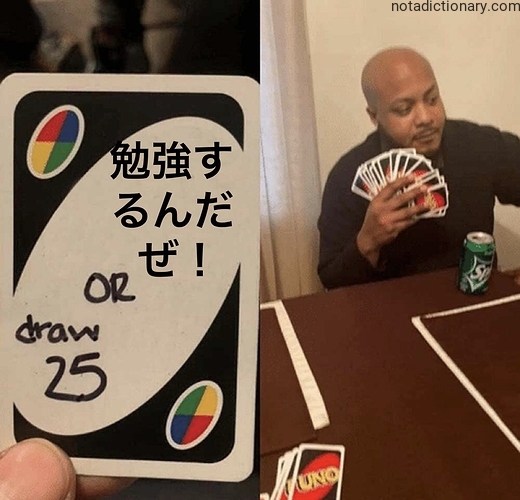
Study hard or draw 25? 😅
Today we gonna break it down once and for all 🧹📋
Both are pieces of work you have to do. But their vibe, life cycle, and emotional damage couldn’t be more different…
🚩🚩 Use TASK when you’re talking about a specific, finite piece of work assigned to you or self-imposed to reach a goal. It usually has a deadline, a clear beginning and end, and once it’s done, you get that sweet hit of dopamine.
➖ Complete the Q3 budget report before 5 PM.
➖ Install the new software update on your laptop.
🚩🚩 Use CHORE when referring to routine, repetitive, and usually tedious maintenance work – especially household duties or administrative upkeep. Chores never truly end; they just wait in the shadows until you drop your guard.
➖ Washing the one pan that’s been soaking in the sink since Tuesday.
➖ Taking out the trash before it starts developing its own ecosystem.
Dictionary says a chore can also mean any tedious or unpleasant task. So if your boss gives you a “task” to format 500 rows of an Excel sheet manually every single morning… congrats, your task just evolved into a soul-crushing chore. 🤷🏻♂️⚡️🙄
To put it simple: 🏆 Task: You finish it, cross it off your to-do list, and feel like a legend.
🧹 Chore: You finish it, and your reward is having to do it again in 24 hours.
Now go clear your sink so you can go back to being productive! 🧽✨
To me and for me are prepositional phrases that are used to express personal thoughts, feelings, or benefits. There are simple rules that will help you choose between to me and for me, although naturally there are subtle shades of meaning depending on the context. For example, both can actually be correct in the same sentence with a different meaning! But before we consider the subtle differences, let’s go over the rules….
🚩🚩 Use to me when expressing a personal opinion, perception, or viewpoint. It is essentially equivalent to saying “in my opinion” or “from my perspective” (“This sweater feels comfortable TO ME”).
🚩🚩 Use for me when something has a direct physical effect, benefit, or impact on you, or relates to your personal convenience or health (“Yoga is great FOR ME”).
So, the rule gonna be 🔠 to me = opinion / for me = benefit or effect 🔠
Ex.
➖That plan sounds risky to me ( expresses personal opinion / viewpoint)
➖Coffee in the morning is essential for me ( direct personal benefit / necessity)
I DIDNT FORGET ABOUT EXCEPTIONS💡
Sometimes you can use both with the same word, but the meaning changes! For example: “This project is important TO ME” means you care deeply about it emotionally. But “This exam is important FOR ME” means it has a direct effect on your future career. Also, when talking about suitableness or convenience, always stick with for (“Is 3 PM convenient FOR ME?”).🤷🏻♂️📌🙄
In the world we all have three important questions we wanna get answers on:
1️⃣ How to find happines?
2️⃣ Who gonna win in a fight, Mark Zuckerberg or Elon Musk?
3️⃣💬👀 And how to figure out what is correct: in the background or on the background.
Today i gonna give u all the answer on the last one💶💶💶
So, how do we know when to use in and on?
In and on are prepositions that are used to describe location, among other things. There are simple rules that will help you choose between in and on for location, although naturally there are exceptions to the rules. For example the phrase “riding on the bus” But before we consider the exceptions, let’s go over the rules….
🚩🚩 Use in when something is located inside of a defined space. It could be a flat space, like a yard, or a three-dimensional space, like a box, house, or car. The space does not need to be closed on all sides (“There is water IN the glass”).
🚩🚩 Use on when something is touching the surface of something. It could be a horizontal surface, like a floor or beach, or a vertical surface, like a wall (“They hung pictures ON the wall”). We also use “on” for the surfaces of body parts (“He has a tattoo ON his arm”).
So, the answer gonna be 🔠 in the background🔠
Ex.
➖Check out those buildings in the background ( is located inside of a defined space)
➖Heavy footsteps were heard in the background (a three-dimensional space/sound in space)
I DIDNT FORGET ABOUT EXCEPTIONS💡
Although we use in with cars, use on for larger vehicles, like planes, trains, and buses (“They have wifi ON the plane”).
To talk about something that is part of a written document, use in, regardless of the format of the document (“The quote appeared IN a blog post”).
With websites, use on.🤷🏻♂️📌🙄
My congrats. Now we only have two questions!
#englishstyleandusage #en
A newspaper article, a biography, a formal explanation, a legal or official document, these are the natural habitats of 姉. It names the relationship cleanly: this person is the older sister of that person. For example, a profile might state that a public figure was raised by 姉 after their mother died – and the word carries no warmth, no distance, no drama. It simply classifies.
News report
容疑者は姉とともに出頭した。
(Yōgisha wa ane to tomo ni shusshō shita.)
“The suspect turned himself in together with his older sister.”
Feeling: neutral, factual, public-register. Same word, same flatness. It names a relationship for the record.
The same neutrality appears in general statements. When someone writes that 姉 often take on a caretaking role in large families, the word is being used generically – not about a particular sister, but about the category. This is where 姉 does its most typical work: in writing, in explanation, in reference to older sisters as a class.
What 姉 is not is the word you would normally use to your own older sister’s face. Spoken address tends to use something else – a name, a kinship term from the child’s perspective, or an honorific form depending on the relationship. 姉 stays outside that intimate space. It is the word you use about her, especially in careful or public language, more than the word you use to her.