🔥 Japanese tweets
📝 Text Meme

Learn Japanese With Memes: Time Flows Slowly Here

Learn Japanese With Memes: Time Flows Slowly Here
Why does time slow down here?
✨Breakdown▼

PHRASES

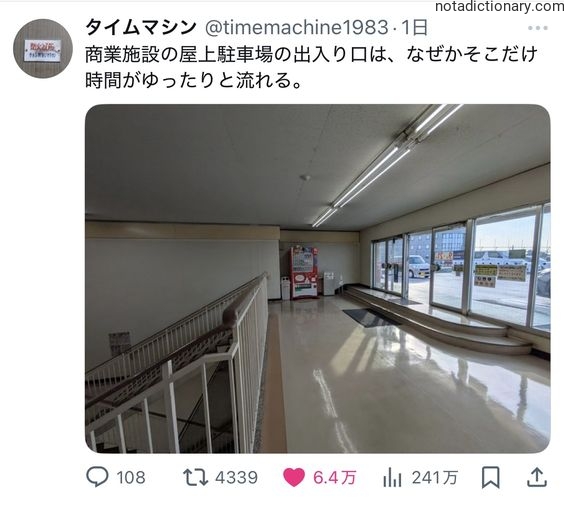
商業施設の屋上駐車場の出入口は、なぜかそこだけ時間がゆったりと流れる。
→ “For some reason, time flows slowly only at the entrance/exit of commercial facility rooftop parking lots.”
商業施設 shō¹gyō¹ shisetsu = commercial facility (noun)
商 shō¹ = trade / commerce
業 gyō¹ = business / industry
施設 shisetsu = facility / establishment
の no = of / possessive particle (nominative/genitive)
屋上 okujō¹ = rooftop (noun)
駐車場 chū¹shajō¹ = parking lot (noun)
の no = of / possessive particle (nominative/genitive)
出入口 deiriguchi = entrance and exit (noun)
は wa = topic marker particle
、 = comma (punctuation)
なぜか nazeka = for some reason / somehow (adverbial phrase)
そこ soko = there / that place (noun/adverb)
だけ dake = only / just (particle/adverb)
時間 jikan = time (noun)
が ga = subject marker particle
ゆったり yuttari = leisurely / relaxed (adverb)
と to = manner particle (indicates state/result)
流れる nagareru = to flow (v.)
。 = period (punctuation)
📐 GRAMMAR ANALYSIS

📌 Topic Marker は (wa)
The particle は (wa) marks the topic of the sentence. In this context, it sets up the subject of discussion: 'As for the entrance/exit...'. It tells the listener what the following statement is about.
Example: “商業施設の屋上駐車場の出入口は... (Commercial facility's...Rooftop parking's...Entrance and Exit[topic]...)”
📌 Restrictive Particle だけ (dake)
The word だけ (dake) means 'only' or 'just'. When placed after a noun like そこ (soko, 'there'), it restricts the scope of the statement to that specific location. It emphasizes that the phenomenon described happens exclusively in that spot.
Example: “なぜかそこだけ時間がゆったりと流れる (For some reasonthat placeonlytime flows leisurely)”
📌 Manner Particle と (to)
The particle と (to) follows an adverb or adjective to describe the manner in which an action occurs. Here, it modifies the verb 流れる (nagareru, 'to flow'). It indicates *how* the time flows: in a leisurely or relaxed way.
Example: “時間がゆったりと流れる (Time[subject]leisurely[manner]flows)”
📌 Verb Inflection: Non-Past Descriptive Form
The verb 流れる (nagareru) is in its dictionary form (non-past). In Japanese declarative sentences describing facts, general truths, or observations, the verb takes this form rather than the past tense. It states a current reality or habitual observation.
Example: “流れる (flows - present/fact form)”
🏠 TO FEED