notadictionary.com
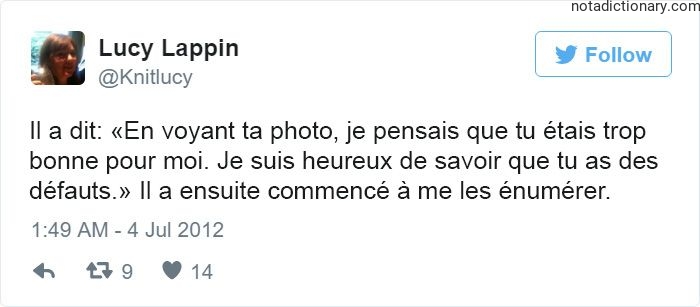
Il a dit: «En voyant ta photo, je pensais que tu étais trop bonne pour moi. Je suis heureux de savoir que tu as des défauts.» Il a ensuite commencé à me les énumérer.
→ “He said: 'Seeing your photo, I thought you were too good for me. I'm happy to know that you have flaws.' He then started listing them for me.”
Il a dit — said (present tense, 3rd-p. singular of dire)
«En — in / by (preposition + gerund marker)
voyant — seeing (present participle of voir)
ta — your (informal singular possessive adjective)
photo — photo (noun; feminine)
, —
je — I (1st-person singular subject pronoun)
pensais — thought (imperfect tense, 1st-p. singular of penser)
que — that (conjunction introducing subordinate clause)
tu — you (informal singular subject pronoun)
étais — were (imperfect tense, 2nd-p. singular of être)
trop — too (adverb indicating excess)
bonne — good (feminine form of bon, used here as an adjective describing the person)
pour — for (preposition indicating benefit or suitability)
moi — me (1st-person singular object pronoun)
. —
Je — I (1st-person singular subject pronoun)
suis — am (present tense, 1st-p. singular of être)
heureux — happy (masculine form of heureux, agreeing with implied subject 'je')
de — of / to (preposition linking verb to infinitive phrase)
savoir — to know (infinitive verb)
que — that (conjunction introducing subordinate clause)
tu — you (informal singular subject pronoun)
as — have (present tense, 2nd-p. singular of avoir)
des défauts — flaws / shortcomings (plural noun; masculine)
» —
Il a — has (auxiliary verb for compound tenses)
ensuite — then / subsequently (adverb indicating sequence)
commencé — started (past participle of commencer, used with auxiliary 'avoir' in passé composé)
à — to / at (preposition introducing infinitive verb)
me — me (reflexive/direct object pronoun, 1st-person singular)
les énumérer — to list / enumerate (infinitive verb)
. —