🔥 Japanese tweets
📝 Text Meme

Learn Japanese With Memes: Confusing Sounds and Expressions

Learn Japanese With Memes: Confusing Sounds and Expressions
Confused by Japanese sounds?
✨Breakdown▼

PHRASES

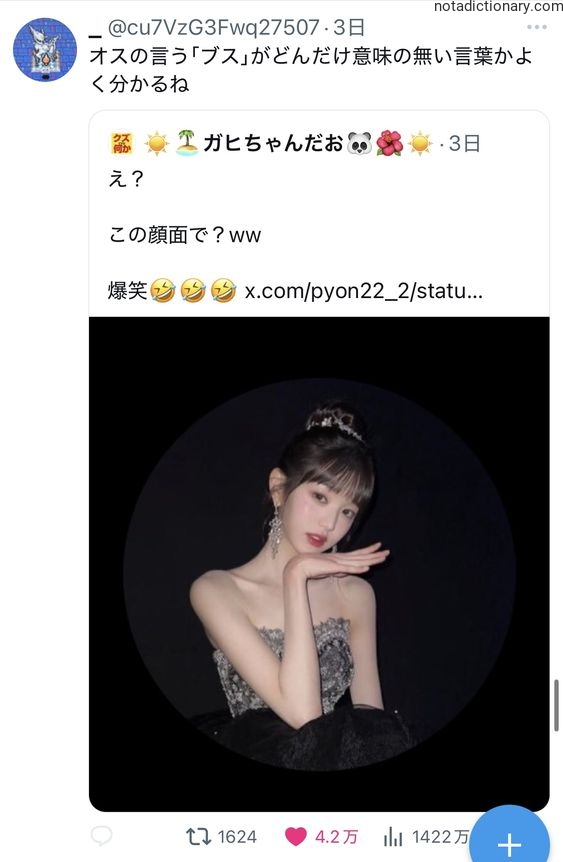
オスの言う「ブス」がどんだけ意味の無い言葉かよく分かるね
→ “You really get how meaningless the word 'busu' (ugly) is when used by a guy, huh?”
オス osu = male / male animal (n.)
の no = 's / of (possessive particle)
言う iu = to say / to speak (v.)
「 = opening quotation mark (punctuation)
ブス busu = ugly / plain (slang noun)
」 = closing quotation mark (punctuation)
が ga = (subject marker particle)
どん don = how much / how many (intensifier)
だけ dake = only / just (limiting particle)
意味 imi = meaning / significance (n.)
の no = 's / of (possessive particle)
無い nai = non-existent / without (adj. na)
言葉 kotoba = word / language (n.)
か ka = question particle (indirect question)
よく yoku = well / clearly / very (adv.)
分かる wakaru = to understand / to realize (v.)
ね ne = huh? / right? (sentence-ending particle seeking agreement)
え?
→ “Huh?”
え e = huh? / eh? (interjection expressing surprise or confusion)
? = question mark (punctuation)
この顔面で?ww
→ “With that face? lol”
この kono = this / these (demonstrative adjective)
顔面 ganmen = face / visage (n.)
で de = with / by means of (instrumental particle)
? = question mark (punctuation)
ww = laughter (internet slang for 'warau' / laughing hard)
📐 GRAMMAR ANALYSIS

📌 The Intensifier "どんだけ" (Don-dake)
In casual Japanese, どんだけ (don dake) is used to mean 'how much' or 'to what extent', often implying a large or excessive amount. It functions similarly to どれだけ (doredake) but is more colloquial and emphatic. In this context, it emphasizes the degree of meaninglessness.
Example: “どんだけ意味の無い言葉 (don dake imi no nai kotoba, "how meaningless a word")”
📌 The Slang Noun "ブス" (Busu)
ブス (busu) is a common slang term for an ugly person, specifically a girl/woman. It is considered quite blunt and rude. Here, it is used ironically or critically to describe the lack of substance in the word itself when spoken by a specific type of person.
Example: “オスの言う「ブス」 (osu no iu 「busu」, "the 'ugly' said by a guy")”
📌 Sentence Ending Particle "ね" (Ne)
The particle ね (ne) at the end of a statement turns it into a tag question seeking confirmation or agreement from the listener. It softens the statement and invites the reader to share the sentiment ('You see?', 'Right?').
Example: “分かるね (wakaru ne, "understand, right?")”
📌 Colloquial Contraction "顔面で" (Ganmen de)
顔面 (ganmen) literally means 'face' or 'visage'. When followed by the particle で (de), it creates a phrase meaning 'with that face' or 'given that expression'. This is often used sarcastically to point out a contradiction between someone's words and their appearance or demeanor.
Example: “この顔面で? (kono ganmen de?, "with this face?")”
🏠 TO FEED