notadictionary.com
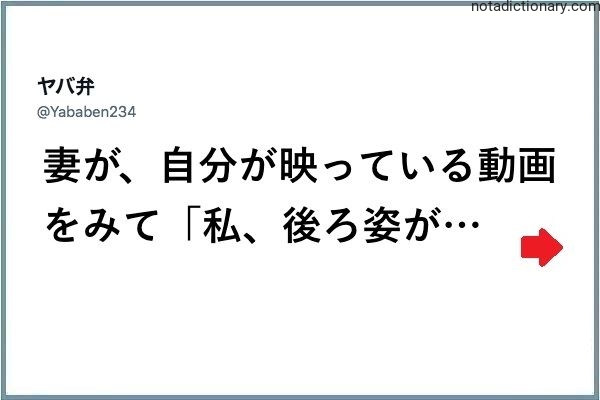
妻が、自分が映っている動画をみて「私、後ろ姿が…
→ “My wife looked at the video of herself and said, 'Me, my back view...'”
妻 tsuma = wife (noun)
が ga = subject marker particle (marks the subject of a sentence)
自分 jibun = oneself / self (pronoun)
自 ji = self
分 bun = part / portion
が ga = subject marker particle (focuses on 'self' as the topic)
映 utsu = to reflect / to show up (verb stem)
っ = elongation mark (extends the previous vowel sound)
て te = continuation form auxiliary (indicates an action leading to the next)
いる iru = to be present / to exist (auxiliary verb)
動画 dō¹ga = video / moving picture (noun)
動 dō¹ = move / motion
画 ga = picture / frame
を o = object marker particle (marks the direct object)
みて mite = looked at / saw (te-form of miru)
見 mi = see / look
て te = continuation form auxiliary
「 = opening quotation mark
私 watashi = I / me (pronoun)
、 = comma (pause in speech)
後ろ ushiro = back / rear (noun)
後 go = after / behind
ろ ro = tail / end
姿 suga = figure / posture / appearance (noun)
が ga = subject/topic marker particle (sets up the incomplete thought)
… = ellipsis (indicates trailing off or suspense)
」 = closing quotation mark