notadictionary.com
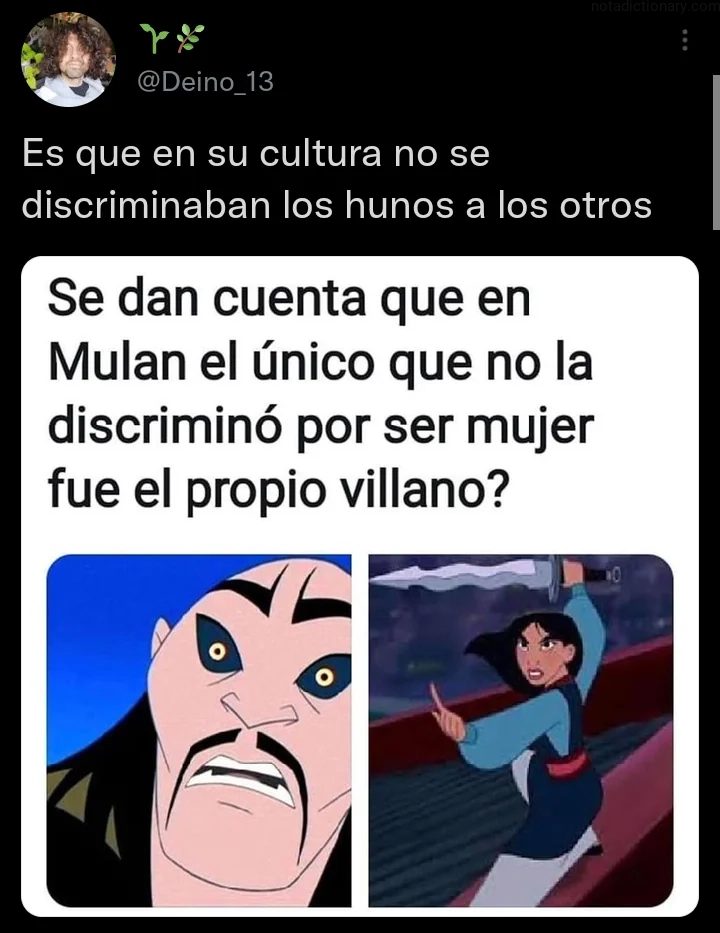
Es que en su cultura no se discriminaban los hunos a los otros
→ “It's that in their culture, the Huns didn't discriminate against others.”
Es [shì] — It is / It's the case that — starting the sentence with a soft, explanatory tone.
que [de] — that — introduces the explanation clause.
en [zài] — in/at — shows location or context.
su [tā de] — their — possessive pronoun showing ownership.
cultura — culture — the customs and beliefs of a group.
no [bù] — not — negates the verb.
se [zìjǐ] — oneself — reflexive pronoun used with passive voice.
discriminaban [pīnpái] — discriminated — the past imperfect tense of 'discriminar' (to discriminate).
los hunos — Huns — refers to the historical nomadic people.
a [duì] — to/towards — preposition indicating direction or recipient.
los otros — others — means 'other people'.
notadictionary.com
Se dan cuenta que en Mulan el único que no la discriminó por ser mujer fue el propio villano?
→ “They realize that in Mulan, the only one who didn't discriminate against her because she was a woman was the villain himself?”
Se [tāmen] — They — reflexive pronoun used with the verb 'darse cuenta'.
dan [jué dé] — realize/perceive — the main verb of the sentence.
cuenta — account/knowledge — part of the phrase 'darse cuenta'.
que [de] — that — introduces the embedded clause.
en [zài] — in/at — shows location or context.
Mulan — Mulan — the Disney movie character.
el único — only — emphasizes exclusivity.
que [de] — that — relative pronoun introducing the clause.
no [bù] — not — negates the verb.
la discriminó [pīnpái] — discriminated — the past imperfect tense of 'discriminar'.
por [yīnwèi] — because — explains the reason.
ser [shì] — to be — infinitive verb form.
mujer — woman — refers to Mulan's gender.
fue [shì] — was — the past tense of 'ser'.
el propio — own — emphasizes that it was the villain himself.
villano — villain — refers to the antagonist in the story.