Difference between

🔥 Difference between
📝 Post

👀 And how to figure out what is correct: HIGH, TALL, or TOWERING?

HIGH, TALL, and TOWERING. They all talk about vertical space, but English loves its subtle shades! Standard dictionaries agree on the distinctions, but if you mix them up, you end up calling your friend a “high person” (which means something very different 🌿😵‍💫).

Let’s go over the rules…

🚩🚩 Rule 1: Use TALL for vertical proportion (from base to top)

Use tall when something is measured from its bottom to its top, especially when its height is noticeably greater than its width. It’s sitting on a surface or the ground!

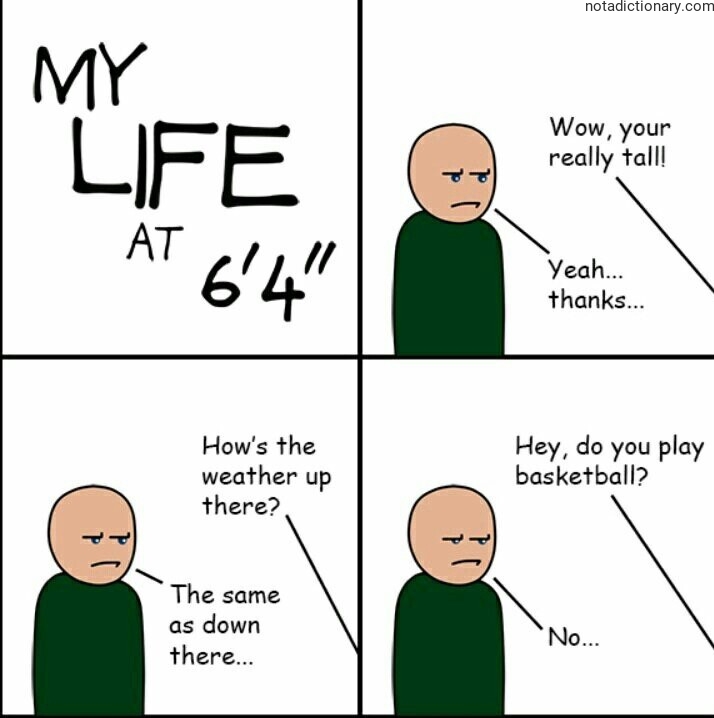
  • 🧍 People: “He’s 6’4″ and tall enough to bump his head on door frames.”
  • 🌲 Objects standing tall: Trees, flagpoles, chimneys, ladders, skyscraper towers.
🚩🚩 Rule 2: Use HIGH for distance above the ground or abstract levels

Use high when something is situated far above the ground/sea level, or when measuring distance off the floor. It doesn’t matter if it’s narrow or wide!

  • 🏔️ Mountains & landforms: “Mount Everest is high, not tall.” (It has a huge, massive base far above sea level!).
  • ☁️ Things elevated in the air: Clouds, airplanes, high shelves, high fences.
  • 📈 Abstract levels: High pitch, high cost, high quality, high stakes.

Ex.

➖ Check out that plane high in the sky! (It’s elevated in space, not standing on feet!)
➖ The room has high ceilings. (Distance from floor to top is large!)

FACT CORNER

Everest vs. Mauna Kea: Height Paradox 🌋

Did you know? Mount Everest is officially the HIGHEST mountain on Earth because its peak reaches 8,848 meters above sea level. But Hawaii’s Mauna Kea is technically the TALLEST mountain in the world—measuring over 10,000 meters from its underwater ocean base to its peak! 🌊 flex.

Did you know?

🚩🚩 Rule 3: Use TOWERING when you need DRAMA, DOMINANCE, and IMPRESSION

Towering is not just about raw physical feet or meters—it’s an emotional gut-punch! Use towering when something is so overwhelmingly tall or impressive that it casts a shadow over everything else around it.

  • 🏙️ “Towering skyscrapers dominated the dark Gotham skyline.”
  • 🦖 “Godzilla stood with towering rage over Tokyo.”
  • 🧠 “Einstein’s towering intellect reshaped physics.” (Yes! Abstract greatness that looms over mere mortals!)

💬 ANECDOTE FROM THE INTERNET ABOUT TALL AND …. i am tired typing so figure out by yourself 💬

A guy walked into a high-end rooftop lounge in Dubai and asked the bartender:
“Excuse me, is this building high or tall?”
The bartender blinked and said: “Sir, the building is tall, the floor is high, and after two of our $30 cocktails, you will be both.” 🍸💸

Why do we say “high mountain” instead of “tall mountain”?

🔥 Difference between
📝 Post

2 words: one feels like building your dream startup and the other feels like a slow descent into madness

1️⃣ What is a Task?
2️⃣ What is a Chore?

Today we gonna break it down once and for all 🧹📋
Both are pieces of work you have to do. But their vibe, life cycle, and emotional damage couldn’t be more different…

🚩🚩 Use TASK when you’re talking about a specific, finite piece of work assigned to you or self-imposed to reach a goal. It usually has a deadline, a clear beginning and end, and once it’s done, you get that sweet hit of dopamine.

➖ Complete the Q3 budget report before 5 PM.

➖ Install the new software update on your laptop.

🚩🚩 Use CHORE when referring to routine, repetitive, and usually tedious maintenance work – especially household duties or administrative upkeep. Chores never truly end; they just wait in the shadows until you drop your guard.

➖ Washing the one pan that’s been soaking in the sink since Tuesday.

➖ Taking out the trash before it starts developing its own ecosystem.

BUT WAIT, THERE’S A TWIST 💡
Can a task become a chore? Oh, absolutely.

Dictionary says a chore can also mean any tedious or unpleasant task. So if your boss gives you a “task” to format 500 rows of an Excel sheet manually every single morning… congrats, your task just evolved into a soul-crushing chore. 🤷🏻‍♂️⚡️🙄

To put it simple: 🏆 Task: You finish it, cross it off your to-do list, and feel like a legend.
🧹 Chore: You finish it, and your reward is having to do it again in 24 hours.

💬👀 Which one make you feel like a CEO?
VS

Now go clear your sink so you can go back to being productive! 🧽✨

🔥 Difference between
📝 Post

💬👀 And how to figure out what is correct: to me or for me.

💬👀 And how to figure out what is correct: to me or for me.

Today i gonna give u all the answer
So, how do we know when to use to me and for me?

To me and for me are prepositional phrases that are used to express personal thoughts, feelings, or benefits. There are simple rules that will help you choose between to me and for me, although naturally there are subtle shades of meaning depending on the context. For example, both can actually be correct in the same sentence with a different meaning! But before we consider the subtle differences, let’s go over the rules….

🚩🚩 Use to me when expressing a personal opinion, perception, or viewpoint. It is essentially equivalent to saying “in my opinion” or “from my perspective” (“This sweater feels comfortable TO ME”).

🚩🚩 Use for me when something has a direct physical effect, benefit, or impact on you, or relates to your personal convenience or health (“Yoga is great FOR ME”).

So, the rule gonna be 🔠 to me = opinion / for me = benefit or effect 🔠

Ex.

➖That plan sounds risky to me ( expresses personal opinion / viewpoint)

➖Coffee in the morning is essential for me ( direct personal benefit / necessity)

I DIDNT FORGET ABOUT EXCEPTIONS💡

Sometimes you can use both with the same word, but the meaning changes! For example: “This project is important TO ME” means you care deeply about it emotionally. But “This exam is important FOR ME” means it has a direct effect on your future career. Also, when talking about suitableness or convenience, always stick with for (“Is 3 PM convenient FOR ME?”).🤷🏻‍♂️📌🙄

🔥 Difference between
📝 Post

How to figure out what is correct: in the background or on the background.

In the world we all have three important questions we wanna get answers on:

1️⃣ How to find happines?
2️⃣ Who gonna win in a fight, Mark Zuckerberg or Elon Musk?
3️⃣💬👀 And how to figure out what is correct: in the background or on the background.

Today i gonna give u all the answer on the last one💶💶💶

So, how do we know when to use in and on?

In and on are prepositions that are used to describe location, among other things. There are simple rules that will help you choose between in and on for location, although naturally there are exceptions to the rules. For example the phrase “riding on the bus” But before we consider the exceptions, let’s go over the rules….

🚩🚩 Use in when something is located inside of a defined space. It could be a flat space, like a yard, or a three-dimensional space, like a box, house, or car. The space does not need to be closed on all sides (“There is water IN the glass”).

🚩🚩 Use on when something is touching the surface of something. It could be a horizontal surface, like a floor or beach, or a vertical surface, like a wall (“They hung pictures ON the wall”). We also use “on” for the surfaces of body parts (“He has a tattoo ON his arm”).

So, the answer gonna be 🔠 in the background🔠

Ex.

➖Check out those buildings in the background ( is located inside of a defined space)
➖Heavy footsteps were heard in the background (a three-dimensional space/sound in space)

I DIDNT FORGET ABOUT EXCEPTIONS💡

Although we use in with cars, use on for larger vehicles, like planes, trains, and buses (“They have wifi ON the plane”).
To talk about something that is part of a written document, use in, regardless of the format of the document (“The quote appeared IN a blog post”).
With websites, use on.🤷🏻‍♂️📌🙄

My congrats. Now we only have two questions!

#englishstyleandusage #en