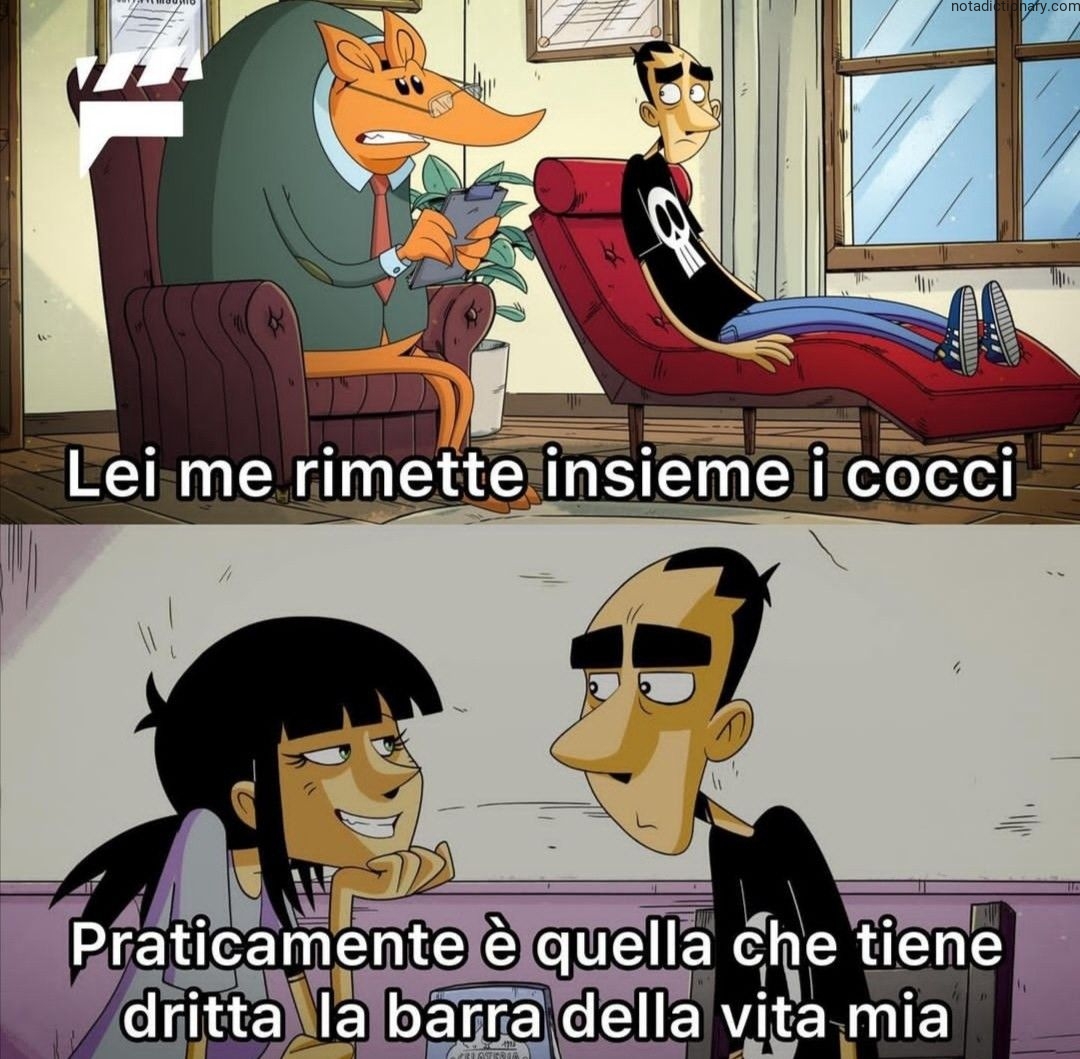
→ “To put the pieces back together / To pick up the pieces”
Rimettere — to put back / to reassemble (verb, infinitive form of rimettere)
i cocci — the pieces / the shards (masculine plural noun with definite article)
notadictionary.com
Lei mi rimette a posto la vita!
→ “She puts my life back together!”
Lei — she (third person singular feminine subject pronoun)
mi — to me / for me (first person singular indirect object clitic pronoun)
rimette — puts back / reassembles (verb, 3rd person singular present tense of rimettere)
a posto — in order / in place / back together (fixed prepositional phrase, idiomatic)
la vita — the life / life (feminine singular noun with definite article)
📐 GRAMMAR ANALYSIS
notadictionary.com
📌 Verb "Rimettere" — Prefix "ri-" for Repetition/Restoration
The Italian verb rimettere is formed by adding the prefix ri- to the base verb mettere (to put). The prefix ri- signals repetition or restoration — doing something again or putting something back the way it was. So rimettere literally means "to put back" or "to put again." In the infinitive rimettere i cocci, it evokes the image of picking up broken shards and reassembling them. In the conjugated form rimette (3rd person singular present), it describes the ongoing action of someone restoring something.
Example: “Rimetterei cocci (To put backthe pieces) — rimettea postola vita (she puts backin orderlife)”
notadictionary.com
📌 Idiomatic Expression "Rimettere i cocci" — To Pick Up the Pieces
The phrase rimetterei cocci is an idiomatic expression in Italian. I cocci literally means "the shards" or "the broken pieces" (of pottery, glass, etc.). Metaphorically, rimetterei cocci means to repair a situation after it has fallen apart — to pick up the pieces of a broken relationship, a failed project, or a chaotic life. The expression is often used with a prepositional complement indicating what is being restored, as in rimettere a postola vita (to put life back in order).
Example: “Rimetterei cocci (To pick upthe pieces) — Leimi rimette a postola vita! (Sheputs my life back together!)”
notadictionary.com
📌 Fixed Prepositional Phrase "A posto" — In Order / In Place
The expression a posto is a fixed prepositional phrase in Italian meaning "in order," "in place," "tidy," or "all right." It is used after verbs like mettere (to put), rimettere (to put back), or essere (to be) to indicate that something is properly arranged or functioning. In the meme, rimette a posto means "puts back in order," describing how she restores order to the speaker's life.
Example: “Rimetterea postola vita (To put backin orderlife) — Tuttoèa posto (Everythingisin order)”
notadictionary.com
📌 Clitic Pronoun "mi" — Indirect Object "To Me / For Me"
The clitic pronoun mi is the first person singular indirect object pronoun, meaning "to me" or "for me." It is placed before the conjugated verb in Italian. In mi rimette a posto la vita, the mi indicates that the action of putting life back together is being done for the speaker — she is restoring my life. This "mi" adds a personal, emotional dimension: it's not just fixing life in general, it's fixing my life specifically.
Example: “Leimirimettea postola vita (Shefor meputs backin orderlife)”
💡 MORE
notadictionary.com
Nuance of Idiomatic Phrase "Rimetterei cocci" ("To pick up the pieces")
The Italian expression rimetterei cocci literally breaks down as rimettere (to put back, from ri- + mettere) + i cocci (the shards/broken pieces). The word cocci specifically refers to fragments of broken pottery or ceramics — think of a shattered vase. The image is vivid: something precious has been smashed, and you are carefully gathering the fragments to reassemble them. In everyday Italian and in memes, this phrase is used metaphorically for any situation where someone (or yourself) is repairing the damage after a crisis — a breakup, a mental breakdown, a career failure. The meme extends this by saying rimettea postola vita (puts life back in order), making it deeply personal and heartfelt.
notadictionary.com
The Prefix "ri-" — Restoring and Repeating Actions
In Italian, the prefix ri- is one of the most productive and versatile prefixes. When attached to a verb, it typically signals either repetition (doing something again) or restoration (putting something back to its original state). For example: ri- + leggere (to read) = rileggere (to re-read); ri- + mettere (to put) = rimettere (to put back); ri- + partire (to leave) = ripartire (to leave again / to restart). In the context of this meme, rimettere carries the restoration sense: life was broken, and she is putting it back together.
notadictionary.com
Fixed Expression "a posto" — In Order, All Right
The phrase a posto is an extremely common fixed expression in Italian meaning "in order," "tidy," "in place," or "all right." It is used with verbs like mettere (to put), rimettere (to put back), and essere (to be). Examples: metterea posto (to tidy up / put away), è tutto a posto (everything is all right / in order), rimetterea posto (to put back in order). In the meme, rimettea postola vita paints the picture of someone who takes the chaos of your life and neatly reassembles it — like tidying a messy room, but for your entire existence.
🍨
Buy Me the Ice Cream
Support our community! Copy any cryptocurrency address below to send your donation.